Skip to main navigation menu Skip to main content Skip to site footer

Vol. 12/13 (2000-2001)

DOI: https://doi.org/10.7264/ajn96583

Published January 1, 2000

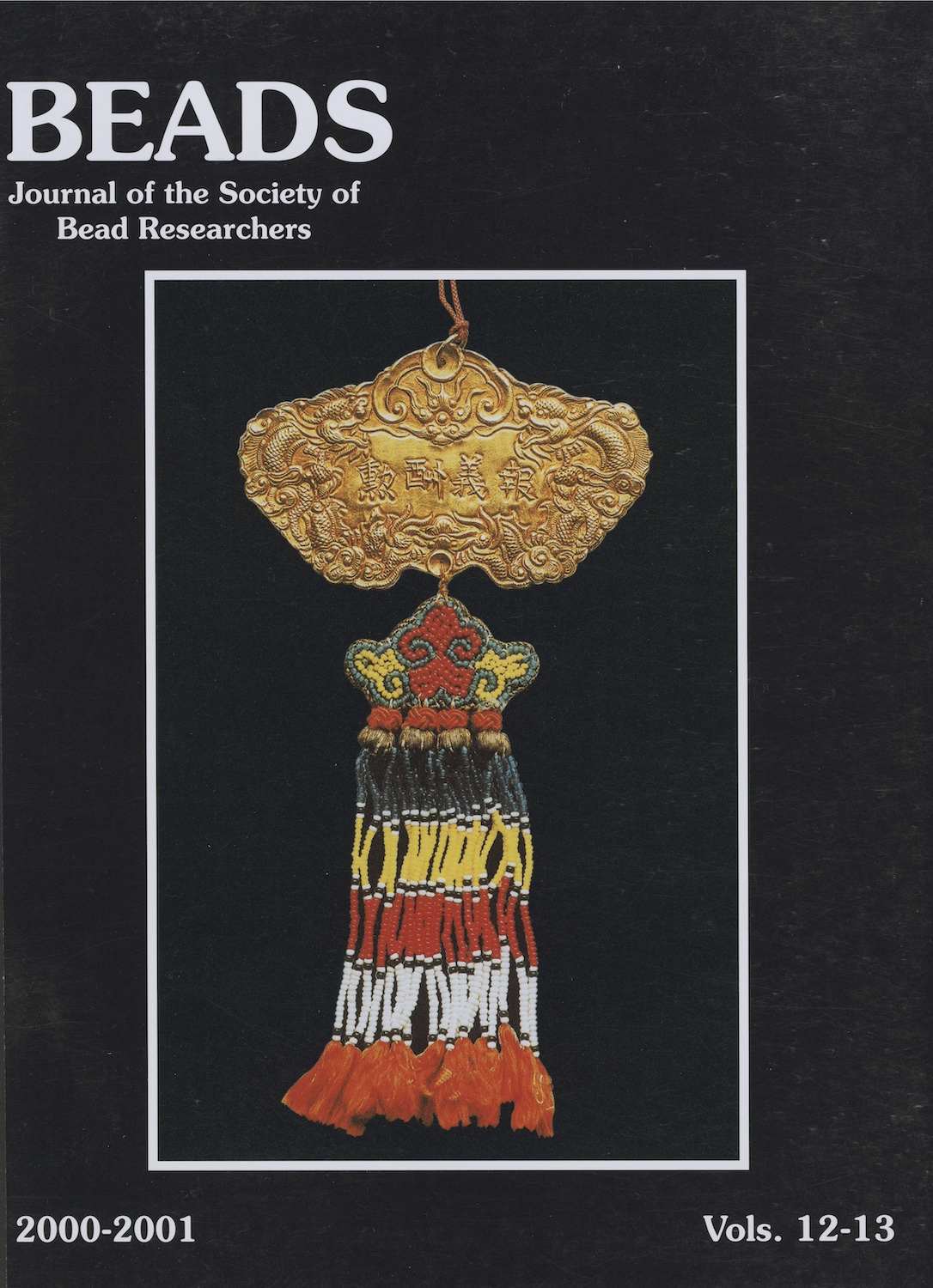
Volume 12/13 cover

Issue description

Volume 12/13 from 2000-2001

Beads is published annually by the Society of Bead Researchers, a professional non-profit corporation which aims to foster serious research on beads ofall materials and periods, and to expedite the dissemination of the resultant knowledge. Subscription is by membership in the Society. Membership is open to all persons involved in the study of beads, as well as those interested in keeping abreast of current trends in bead research.

Articles

  1. Annamese Orders: Precious Metal, Tassels, and Beads

    Over the centuries, beads have been used for myriad purposes but a seemingly unique application is their use as components of several types of Annamese orders. Now known as Vietnam, the State of Annam issued a number of civil awards during the late 19th and early 20th centuries. Four of these—khahn, boi, tien, and bai—were made of precious materials and incorporated bead strands and tassels in their composition. The khanh was reinstated as the second-ranking civil order of the Republic of Vietnam in 1957.

  2. Stone Beads and Sealstones from the Mycenaean Tholos Tomb at Nichoria, Greece

    Stone beads and engraved sealstones are among the most common grave goods that accompany Mycenaean burials. At Nichoria in the southwestern Peloponnese of Greece, a tholos tomb, presumably the burial place of the local elite at the site, had been plundered more than once in antiquity before being investigated by archaeologists. Nonetheless, it produced numerous stone beads of rock crystal, amethyst, carnelian, agate, and "steatite." Eleven sealstones, most of which were heirlooms when placed in the tomb, were also found among the disturbed burial offerings.

  3. Identifying Sources of Prehistoric Turquoise in North America: Problems and Implications for Interpreting Social Organization

    Well-made turquoise beads are rare in North American archaeological sites, and the prehistoric sources of turquoise are limited. Mining the turquoise, manufacturing the bead, and using it as part of a bracelet or necklace involve numerous human interactions to transport the raw material from its source to the place where it is finally found in an archaeological context. Accurate identification of turquoise sources affects our interpretation of prehistoric behavior and is the focus of this paper.

  4. Man-in-the-Moon Beads

    The unique and memorable design of man-in-the-moon beads has intrigued researchers over the years. These distinctive beads were identified in the 1960s by George Quimby as being chronologically diagnostic of Middle Historic Period sites (1670-1760) in the western Great Lakes region. The present study more clearly defines both the temporal and geographical instances of man-in-the-moon beads while taking into account possible cultural and historical implications. This project has led to the compilation of information regarding many specimens previously unknown to most researchers.

  5. The Stone Bead Industry of Southern India

    Although previously unrecognized, South India was once home to a major stone-beadmaking industry. At its zenith in the early centuries A.D., it exported beads eastward to other parts of Asia and westward to the Roman Empire. South Indian gems were of such importance to the Roman West that the region deserves the title of "Treasure Chest of the Ancient World." Research has identified the probable sources of nearly all the raw materials used, the lapidary centers, and the trade routes over which the finished beads would have traveled. Additionally, it has revealed that the principal participants in the industry were the Pandukal people, opening a new chapter on the widening understanding of this community.

  6. The Krobo and Bodom

    Certain relatively large beads, almost always found in Ghana, have come to be called "bodom" by bead traders, collectors, and researchers. Most students of this bead believe it is the product of the Krobo powder-glass industry proliferating today in southeastern Ghana. Upon closer inspection, however, there appear to be two distinct groups of bodom that we may, for convenience, call "old" and "new." While the new bodom are definitely made in Ghana today, using techniques that have been observed and documented, the old bodom are substantially different in enough ways to suggest that they were made elsewhere by other methods. This study examines the origins and methods of manufacture of bodom and tests the hypothesis that the Krobo made oldbodom.