Skip to main navigation menu Skip to main content Skip to site footer

Volume 35

DOI: https://doi.org/10.7264/2fpren98

Published January 1, 2023

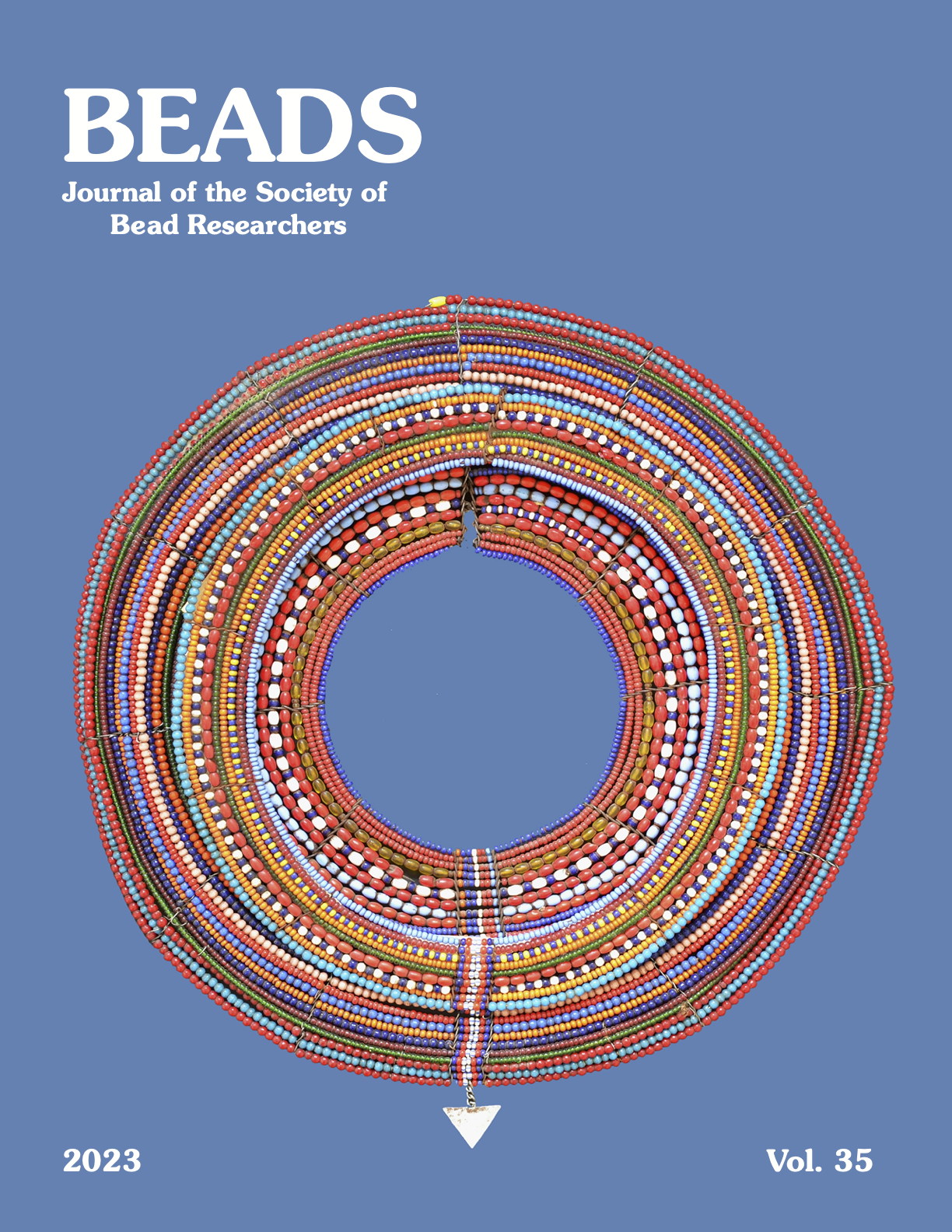
Volume 35 cover

Issue description

Beads is published annually by the Society of Bead Researchers, a non-profit scientific-educational organization which aims to foster serious research on beads and beadwork of all materials and periods, and to expedite the dissemination of the resultant knowledge. Subscription is by membership in the Society. Membership is open to all persons involved in the study of beads, as well as those interested in keeping abreast of current trends in bead research.

Articles

  1. The Beaded and Associated Adornments of the Maasai

    The lavish beaded jewelry of the Maasai developed from comparatively modest beginnings. Since glass beads were originally a costly rarity in landlocked East Africa, elaborate beaded adornments only became possible in the second half of the 20th century. There are descriptions and illustrations of early objects in the publications of German and British colonial officials such as Moritz Merker and Claude Hollis, but much has been learned since their time. This paper describes the beaded jewelry and utilitarian objects of the Maasai, including their traditional Maa proper names, as well as the glass beads and other materials used in their construction.

  2. Catlinite Beads: Les Autres Diamas du Pais

    Archaeological evidence is combined with 17th-century documents to record the production of red stone beads by Anishinaabe communities in southern Ontario for exchange with neighboring Iroquoian populations as far away as the Seneca in upstate New York. A transition from local red siltstone to exotic catlinite appears to have been influenced by the mid-century Iroquois Wars, while the symbolism inherent in these items may have been related to the introduction of European diseases.

  3. Preliminary Analysis of the Stone, Glass, and Metal Beads, Agusan River Valley, Mindanao, Philippines

    The Agusan River Valley in Mindanao, Philippines, has great archaeological significance, particularly for the Age of Contacts and Trade. Intensifying pothunting activities, however, complicate the systematic study of the region due to the loss of the artifacts’ stratigraphic context. This article is concerned with the archaeological research potential of beads recovered from disturbed contexts by presenting results from the multi-level analysis of 200 stone, glass, and metal beads donated to the Agusan River Valley Archaeology and Heritage Project. Descriptive and typological analyses reveals a preference for certain bead shapes and colors, while preliminary compositional analysis identifies similarities with colorants used in glass beads excavated in Indonesia, Malaysia, and Singapore. These results provide insights into the cultural lives of precolonial communities along the Agusan River Valley and their participation in a wider interregional exchange network.

  4. Exploring Local Glassmaking and Social Significance: Gilded Glass Beads in Colonial Mexico City

    This article centers on gilded glass beads discovered through excavations conducted by the Instituto Nacional de Antropología e Historia in Mexico City, with a particular focus on the collection from the Convent of the Incarnation. This study challenges two prevalent notions regarding these artifacts in New Spain. Firstly, the archaeological context defies the conventional belief that these beads were exclusively intended for Indigenous or African-origin populations. Evidence suggests that these items were also a component of the attire worn by Spanish women of Peninsular and Creole origin who constituted the local elite. Secondly, by combining archaeological findings with historical sources, it becomes evident that the viceroyalty fostered a specialized glassmaking industry for the production of small objects, including beads. The practice of beadmaking in New Spain commenced during the 16th century and experienced its zenith in the 18th century, characterized by the emergence of distinctive stylistic features that probably included gilded beads.

  5. Bead Color Symbolism and Colonialism in the Mohawk Valley during the Late 17th Century

    Scholarship has long recognized the significance of glass beads in post-Columbian North America. For Northeastern Native Americans, beads were relationally entangled within sociopolitical relationships and the spiritual world. In the Mohawk Valley of eastern New York state, bead types and colors have been useful temporal markers, but their social and spiritual significance has received less attention. This paper seeks to address the metaphysical significance of glass beads from the Veeder (Fda-2) site, a late 17th-century Mohawk village in eastern New York state. Through the interpretation of color symbolism, the Veeder bead assemblage can be contextualized alongside multi-scalar phenomena such as colonialism, disease, warfare, and the large-scale emigration of Catholic Mohawks. Indeed, the selection of specific bead colors can shed light on the villages’ inhabitants state of being and provide a way to further understand the intersection of colonialism and Native American interaction.

  6. Analyzing Aesthetics and Contemplating Cosmologies: Glass Beads and the Socio-Political Economies of the Haudenosaunee Confederacy, ca. 1655-1754

    This paper compares glass bead color, shape, and size patterns from 19 Seneca, Cayuga, Onondaga, Oneida, and Mohawk towns, ca. 1655-1754. During this time, Haudenosaunee (also known as Iroquois) Nations sought trading relationships with Europeans and other Indigenous communities to obtain goods by choice, rather than by dependence. As actors with agency, Haudenosaunee Nations intentionally sought specific visual characteristics of glass beads to generate desired outcomes. Within the context of Haudenosaunee cosmology, the colors red, white, and black have aesthetic and ideological power because their animacy evokes dynamic states of being and facilitates transformation. Considering glass bead color, shape, and size patterning across multiple contemporaneous towns in the Haudenosaunee Confederacy illuminates nation-specific aesthetic preferences, trends in bead use, and draws attention to Haudenosaunee economic and aesthetic motivations for wearing and exchanging glass beads during the fur trade.

Reviews