Skip to main navigation menu Skip to main content Skip to site footer

Volume 34

DOI: https://doi.org/10.7264/g36j0y77

Published January 1, 2022

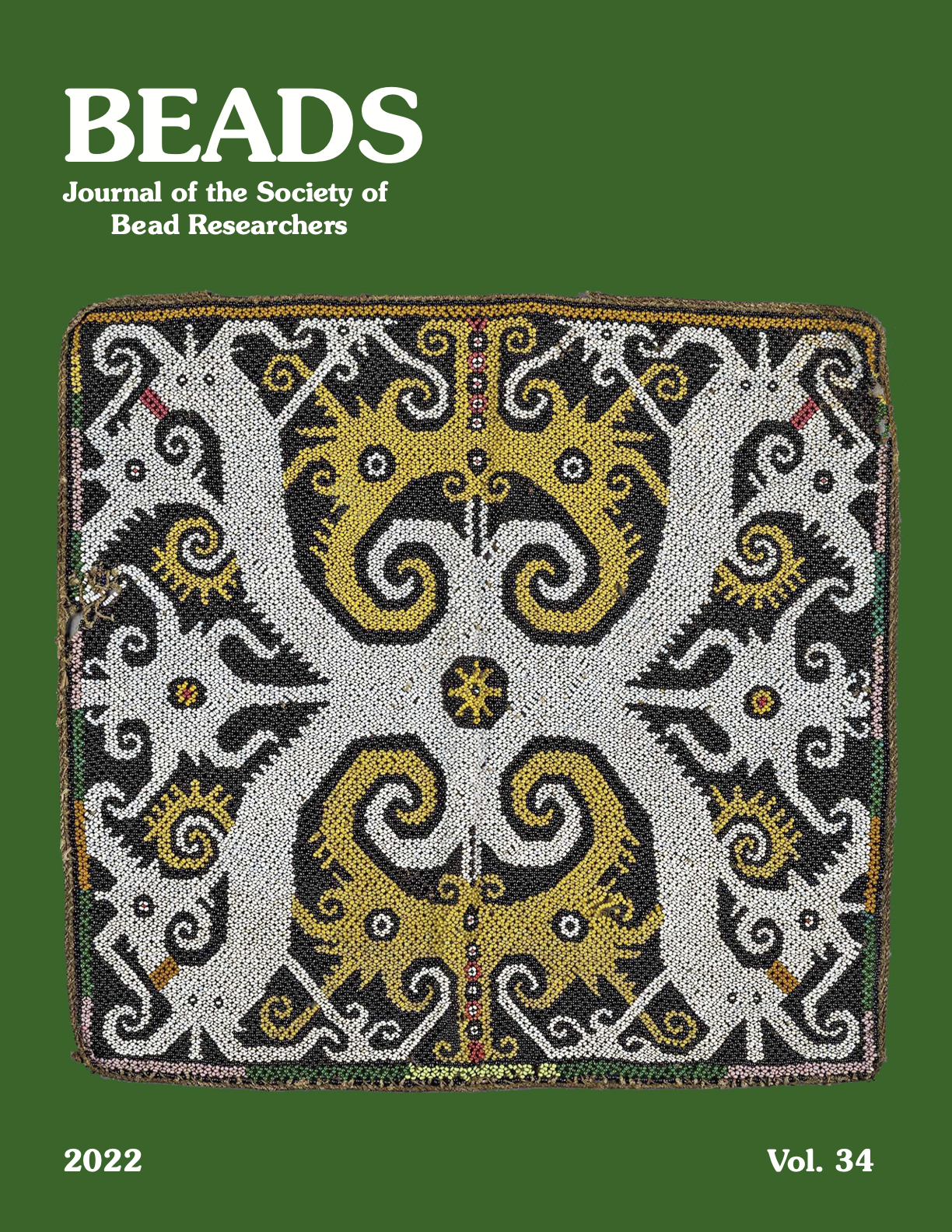
Volume 34 cover

Issue description

Beads is published annually by the Society of Bead Researchers, a non-profit scientific-educational organization which aims to foster serious research on beads and beadwork of all materials and periods, and to expedite the dissemination of the resultant knowledge. Subscription is by membership in the Society. Membership is open to all persons involved in the study of beads, as well as those interested in keeping abreast of current trends in bead research.

Articles

  1. Evoking the Aso': Dayak Beaded Baby Carrier Panels with Dragon-Dog Motifs

    Although fairly well known, beaded baby carriers made by the Dayak peoples of Borneo have not been well studied. This paper focuses on one element of carrier decoration: the square or rectangular bead-plaited or -woven panels known as aban or tāp hawat in Dayak languages. Designed by men, beaded by women, aban harness spiritual power, deploying talismanic motifs that help protect a child’s body and soul from harm in the vulnerable first few years of life. One of the most potent motifs is the aso’ or dragon-dog, an imaginary creature of the watery underworld, feminine in nature, a goddess-like being the Dayak depict in many media besides beads. Analyzing eleven aban dating to ca. 1896-1965, nine of which are previously unpublished, we trace the guises aso’ assume, witnessing impressive artistic achievements while posing questions for further research.

  2. The Bead Trade during the Late Third and Second Millennia BC at the Island of Failaka, Kuwait, Upper Persian Gulf

    The island of Failaka (Kuwait) is favorably situated in the Persian Gulf at the inlet of the Mesopotamian harbor cities of the 3rd to 2nd millennia BC. The island was investigated between 1958 and 2017 by several different archaeological projects focusing on the remains from the Bronze Age. Two settlements (Al-Khidr and Tell F3) and two large monumental buildings (Tell F6) were uncovered. A substantial number of beads made from semiprecious stones (carnelian, agate, jasper, turquoise, and lapis lazuli) were found. Lesser numbers were made of glass, faience, and paste, as well as bone, shell, ostrich eggshell, and clay. The majority of the beads must have been brought to the island as finished goods since raw materials for their production were not locally available and little evidence of bead production has been identified on the island. The beads found at Failaka suggest that the island was tied into extensive trading networks reaching from the Indus region to the Mediterranean.

  3. Heirloom Beads among the Dayak of Borneo

    Research on Borneo’s heirloom beads has so far largely focused on the Dayak tribes of Sarawak in Borneo’s north. To expand the study area, the author has undertaken fieldwork in both Sarawak and Kalimantan and focused on Borneo’s links with regional and international trade routes along which its heirloom beads traveled. A further area of research has been British and Dutch colonial literature and collections of heirloom beads outside Borneo.

  4. Peake, Wampum, or Sewant? An Analysis of Shell Bead Terminology in the Seventeenth-Century Chesapeake

    Beads and the terminology used to describe them provide a powerful look into the colonial relationships negotiated by both Indigenous groups and European settlers. Peake, wampum, and sewant are terms used by both groups to describe tubular white or purple shell beads that developed as a result of colonial interactions between them. This paper uses 17th- and 18th-century documents from Virginia and Maryland to examine the contexts in which bead terminology shifted throughout the region over time. In examining these shifts from the Chesapeake vernacular, this paper provides another avenue by which to understand not only how people used beads to negotiate colonial relationships, but also to demonstrate who was building relationships with whom and the effects of those relationships.

  5. Northwest Cambodia and the Mekong Interaction Sphere: Glass and Stone Beads from Lovea, Prei Khmeng, and Sophy

    This paper reviews stone (agate and carnelian) and glass bead assemblages from three sites in northwest Cambodia: Lovea, Prei Khmeng, and Sophy. Beads from all three sites were largely found in burial contexts dating to the Iron Age or protohistoric period (500 BCE-500 CE). While stone and glass beads are frequently markers of contact with South Asia, they are also informative for understanding intra-regional exchange networks within Southeast Asia. An analysis of the glass beads identifies that most beads were made from a high-alumina mineral soda glass. Compositional and morphological analysis of the stone beads suggests that beads were likely produced from an Indian raw material source and using South Asian production techniques. Overall, the bead assemblages from all three sites show connections to other sites in Cambodia and Thailand and especially seem to be part of the broader Mekong Interaction Sphere exchange network.

  6. The Beads of Athribis, Middle Egypt: an Overview after 10 Years Excavation

    It was in 2012 that the University of Tübingen started the proper excavation of the temple of King Ptolemy XII at Athribis. This temple was reused for many years during the Late Roman (Coptic) and medieval (Islamic) periods until its destruction between the mid-10th and the mid-11th century. During that time the temple was filled with debris and rubbish, and several rooms were temporarily used as animal pens. Beside a variety of objects such as wood, fabrics, and coins, we found hundreds of beads, several pendants, and other jewelry like horn bracelets, bronze rings, and hair needles. We have started to classify the beads in order to produce a catalog of all the jewelry as a basis for further in-depth research.