Skip to main navigation menu Skip to main content Skip to site footer

Volume 32

DOI: https://doi.org/10.7264/c19c6q86

Published January 1, 2020

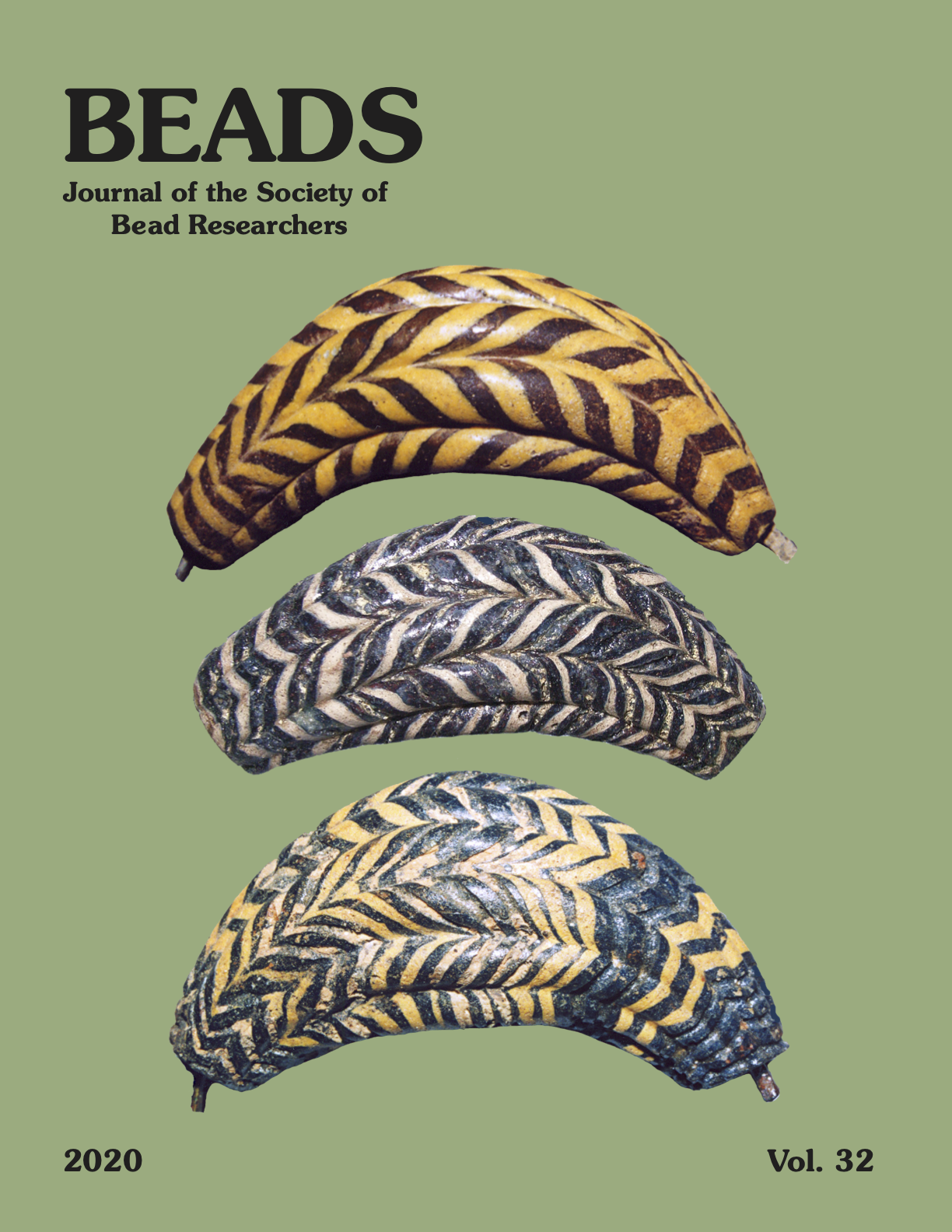
Volume 32 cover

Issue description

Beads is published annually by the Society of Bead Researchers, a non-profit scientific-educational organization which aims to foster serious research on beads and beadwork of all materials and periods, and to expedite the dissemination of the resultant knowledge. Subscription is by membership in the Society. Membership is open to all persons involved in the study of beads, as well as those interested in keeping abreast of current trends in bead research.

Articles

  1. The Large Glass Beads of Leech Fibulae from Iron Age Necropoli in Northern Italy

    During the Iron Age, around 700 BC, artisans in northern Italy produced bronze bow fibulae decorated with large, elongated, leech-shaped glass beads. These extraordinary brooches, known only from women’s tombs, required special technical knowledge and skill to create. This article provides an overview of these adornments as well as insights into their production technology, chemical composition, and origin. The wide variety of these objects suggests the existence of several local glass workshops.

  2. Ancient Egyptian Sulfur Beads

    The Ancient Egyptian and Near Eastern Collection at Tokai University (AENET), Japan, contains two unique necklaces made of an opaque yellow substance identified as sulfur through XRF and XRD analysis. Sulfur beads are rare and have not been adequately studied. We therefore undertook a study of the AENET beads and estimate that they date to the Ptolemaic and early Roman periods in Egypt. A digital-image comparison between the AENET beads and similar beads in another museum collection shows a strong correlation, suggesting that they share a single mold. An isotopic analysis also provides a specific fingerprint of the sulfur. Experiments to replicate the beads indicated that they were made by pouring molten sulfur into a greased mold. The process is simple, revealing that a small-scale cottage industry was sufficient to make them. The beads were used for funerary purposes (likely incorporated into broad collars) rather than in daily life because oxidized sulfur emits an unpleasant odor, discouraging people from wearing them every day.

  3. Barikot Beads and Gandharan Art Ornaments: A Critical Study of Adornment Practices during the Kushana Period of Pakistan

    To reconstruct and understand adornment practices during the Kushana period of Gandhara (1st-3rd centuries CE), this article compares selected examples of beads recovered from the stratigraphically excavated site of Barikot (Swat Valley, Pakistan) with the forms of beads carved into regional iconography, i.e., sculptures of Bodhisattva (Buddhist divine beings) deriving from the Gandharan world. This article evaluates bead shape, size, and style to determine if the carved depictions represent actual ornaments or if they are simply symbolic or imaginative. This analysis can provide new insight into how ornaments were worn in the early historic period of South Asia and into the accuracy of iconographic depictions.

  4. The Blue Beads of St. Eustatius: New Perspectives from Archaeology and Oral History

    The blue beads of St. Eustatius are a famous symbol of the island’s heritage, evoking both positive and negative emotional responses in local stakeholders. Archaeologists often encounter oral historical accounts to explain the functions of the blue beads in colonial society. Until now, these accounts have not been thoroughly recorded, investigated, or integrated with other sources of data. Oral historical interviews conducted in 2016 provide information on the role of the blue beads in enslaved and free communities. We discuss these findings and their relation to archaeological evidence on the island as well as elsewhere in the Americas and West Africa. Such involvement of local people in the interpretation of their own heritage encourages the decolonization of archaeology, and we hope that this approach will become standard throughout the Caribbean region.

  5. Furnace-Wound Glass Bead Production at Schwarzenberg am Böhmerwald, Upper Austria

    Exploratory excavations carried out in Schwarzenberg am Böhmerwald, Upper Austria, uncovered the remains of an unrecorded glassworks. Part of a furnace was exposed, along with glass beads and buttons, as well as holloware and flat glass fragments from the 17th and early 18th centuries. This article describes the finds and their relationship to the nearby Sonnenschlag glassworks where similar beads and glassware fragments have been collected. Both sites are related to the beadmaking industry in the nearby Bavarian and Bohemian forests, which experienced a veritable bead boom around 1700.

  6. The Beads from an 18th-Century Acadian Site, Prince Edward Island, Canada

    Excavation of the Pointe aux Vieux site, an 18th-century Acadian house located on western Prince Edward Island, Canada, yielded a significant assortment of beads. Among the glass and bone specimens are ten black beads decorated with undulating yellow lines around the middle. Commonly called “rattlesnake” beads by collectors, this stylistic form has been found at many sites in North America as well as elsewhere in the world. Unlike the other beads, however, the ones from Pointe aux Vieux are not glass but formed by melting an igneous rock called “proterobas” to form a totally opaque black glass. The only known source of beads made from this material is the Fichtelgebirge region of northeastern Bavaria. While black ball buttons made of proterobas have been encountered at various sites in the eastern United States and Western Europe, this is the first recorded instance of proterobas beads in North America. It is hoped that this article will lead to more such beads being identified in archaeological collections so that their distribution and temporal range may be determined.

  7. A New Way to Study Ancient Bead Workshop Traditions: Shape Analysis Using Elliptical Fourier Transforms

    A new analytical methodology using trigonometric functions of Elliptical Fourier transforms (EFTs) is presented for studying morphometric proportions of stone beads. The methodology was tested using ethnographically produced bead types from a single workshop compared to a discrete assemblage of stylistically similar archaeological beads from the Levant. The two-dimensional outlines of the shapes of both sets of beads were analyzed using the same methodology and EFTs were used to classify beads by their stylistic types and calculate their average morphometric values. These data defined the variation present within a techno-stylistic workshop tradition. EFT data from the modern bead groups were compared to the archaeological samples and both shared the quantitative characteristic of a single workshop tradition. The archaeological samples can be interpreted as reflecting a distinctive workshop tradition. This pilot study suggests that EFT analysis provides meaningful, empirical demonstrations of shared group membership, in terms of style and metrics.