Skip to main navigation menu Skip to main content Skip to site footer

Volume 30

DOI: https://doi.org/10.7264/dpymq802

Published January 1, 2018

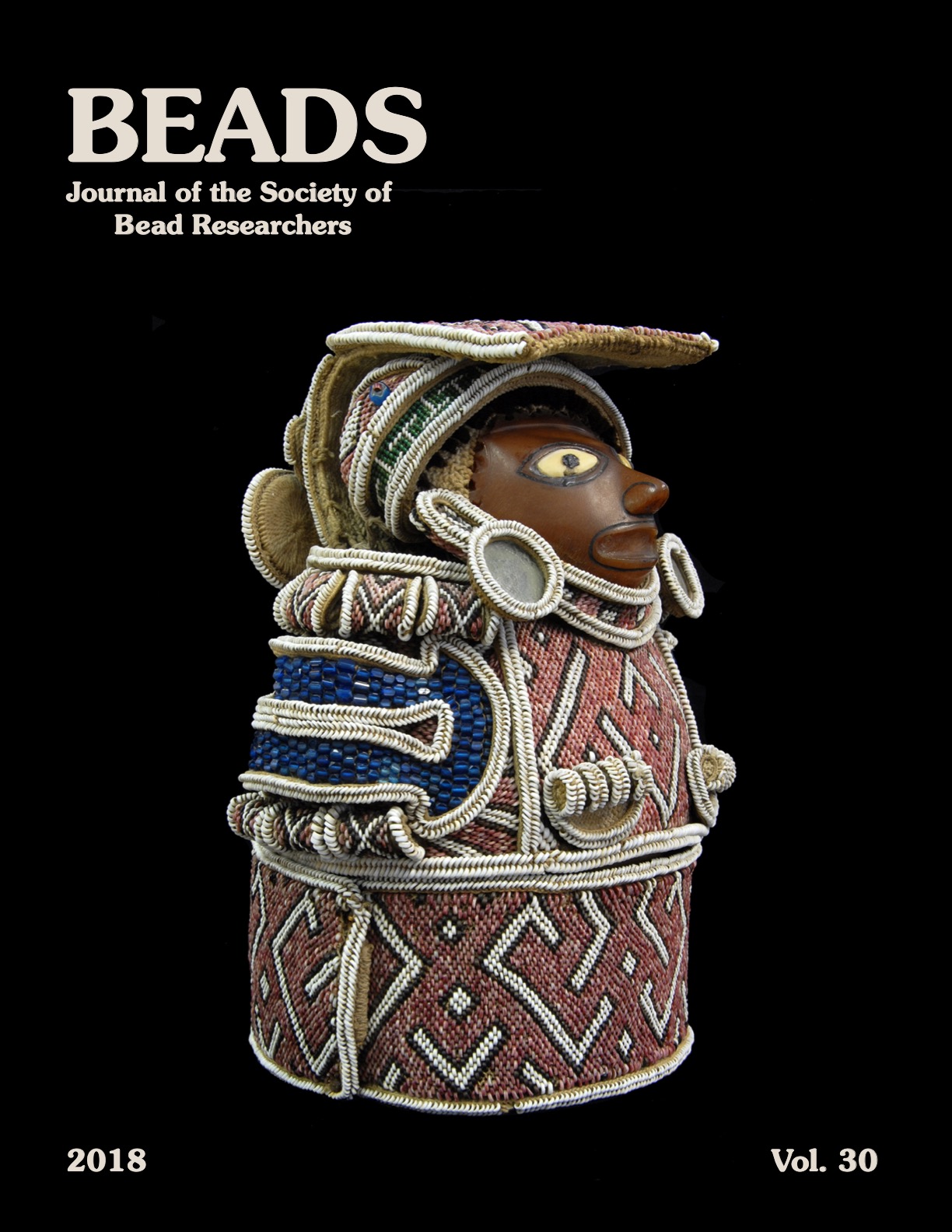
Volume 30 cover image

Issue description

Beads is published annually by the Society of Bead Researchers, a non-profit scientific-educational organization which aims to foster serious research on beads and beadwork of all materials and periods, and to expedite the dissemination of the resultant knowledge. Subscription is by membership in the Society. Membership is open to all persons involved in the study of beads, as well as those interested in keeping abreast of current trends in bead research.

Articles

  1. To Produce “a Pleasing Effect:” Taíno Shell and Stone Cibas and Spanish Cuentas in the Early Colonial Caribbean

    This article serves as an introduction to the use of beads – both indigenous and European – in surviving examples of body ornaments of the early colonial period Caribbean: a cemí/belt in the collections of Rome’s Museo Nazionale Preistorico Etnografico “L. Pigorini,” a belt from the Weltmuseum Wien, and a cache of beads in a wooden vessel from the collections of the Museo de Historia, Antropología y Arte, Universidad de Puerto Rico. These artifacts offer insights into how the Taíno may have adopted newly introduced foreign goods, aligning them to their own aesthetics and world view. Glass beads, acquired via visitors from foreign lands, entered into a well established repertoire of indigenous shell, stone, and potentially botanical beads, introducing different colors and finishes, but nevertheless fitting within traditional cultural expressions and value systems.

  2. Glass Beads in Iron-Age and Early-Modern Taiwan: An Introduction

    Archaeological research has revealed a long history of glass bead exchange and use in Taiwan, yet it has seldom been discussed in the literature. This paper provides an introduction to this exchange from the Iron Age (ca. late 1st millennium BC – mid-2nd millennium AD) to the early modern period (ca. AD 1600-1900) by revisiting the archaeological and historical records. It is suggested that changes in bead styles and chemical compositions over time reveal the transition of bead supply in Taiwan, which further reflects two broad phases of bead trade: Phase I) the earlier involvement of Taiwan in the Indo-Pacific bead exchange (1st millennium AD) and Phase II) the later cultural and economic contacts between the indigenous people, Chinese merchants, and Europeans (2nd millennium AD).

  3. Beyond the Nubian Gold: Meroitic Beads between the Fifth and Sixth Nile Cataracts

    More than 2,300 beads and pendants were excavated from 16 graves at the Berber Meroitic cemetery (BMC) during the 2009-2013 seasons. The site lies between the Fifth and Sixth Cataracts, some 150 km north of the kingdom’s capital, Meroe. The cemetery has been dated to between the 2nd century BC and the 3rd century AD. Next to some ostrich-eggshell, stone, and silver beads and pendants, faience, glass, and metal-in-glass dominate the bead assemblage, with the latter type (gold-in-glass and silver-in-glass beads) constituting a quarter of the finds. Some of the metal-in-glass specimens belong to one of the most sophisticated bead types, being decorated with an impressed lozenge motif on one side and the figurative motif of Harpocrates on the other. In general, the diversity of bead types makes the Berber assemblage comparable to other Meroitic collections from Lower Nubia to the north and from the Meroe royal cemetery to the south. It also contributes new bead types to Meroitic beadwork.

  4. Florida Cut-Crystal Beads in Ontario

    Faceted rock-crystal beads attributed to ca. 1550-1630 have been found at a number of North American archaeological sites, principally in the southeastern United Sates where they are generally termed Florida Cut-Crystal. Finds further to the north are rare. It was, therefore, of great interest to discover three different examples in the bead collections of two 17th-century Huron-Wendat sites in southern Ontario: Le Caron (BeGx-15) and Warminster (BdGv-1). The beads are investigated using a multi-disciplinary approach in an effort to determine how and where they were produced.

  5. More Pipeclay Beads from Norton St Philip, England

    During the 17th century, Norton St Philip was a major production center for clay tobacco pipes. As a sideline, they also made such items as wig curlers, gaming pieces, and beads. A previous article discussed six beads recovered from pipe-making wasters in fields adjoining the village. Here are described an additional five specimens, each with different decoration.

  6. More on Frit-Core Beads in North America

    This article publishes new findings on frit-core beads in North America, including an initial assessment of their chemical composition. Two new find sites have been added to the inventory, bringing the total to 19. In addition, two new types have been recorded, each with variants. The bead from one of the new sites comes from a context later than the date range attributed to this bead category. Its significance is discussed.

  7. Sourcing a Unique Man-in-the-Moon Bead

    Chemical analysis of a unique black bead found in Turkey that depicts the four phases of the moon reveals it most likely originated in the Fichtelgebirge region of Bavaria at some time prior to the early 19th century.

  8. Stone Beads in Oman During the 3rd to 2nd Millenia BCE: New Approaches to the Study of Trade and Technology

    This paper focuses primarily on ancient stone beads found in Oman at sites dating to the 3rd to 2nd millennium BCE, generally dated to the Umm an-Nar and Wadi Suq periods. Archaeological collections were documented to determine the range of variation in the finished objects and if there is evidence for local production of carnelian and other hard-stone beads. A comparative analysis with published materials from other regions was also undertaken to document the bead types in Oman that might have been obtained through trade networks that linked this region to Mesopotamia, Iran, the Indus Valley region, Afghanistan, Egypt, and Anatolia. The overall outcome of this study is a more comprehensive understanding of the types of interactions that were carried out between communities in Oman and adjacent regions during the prehistoric period.