Skip to main navigation menu Skip to main content Skip to site footer

Volume 27

DOI: https://doi.org/10.7264/my2ttc26

Published January 1, 2015

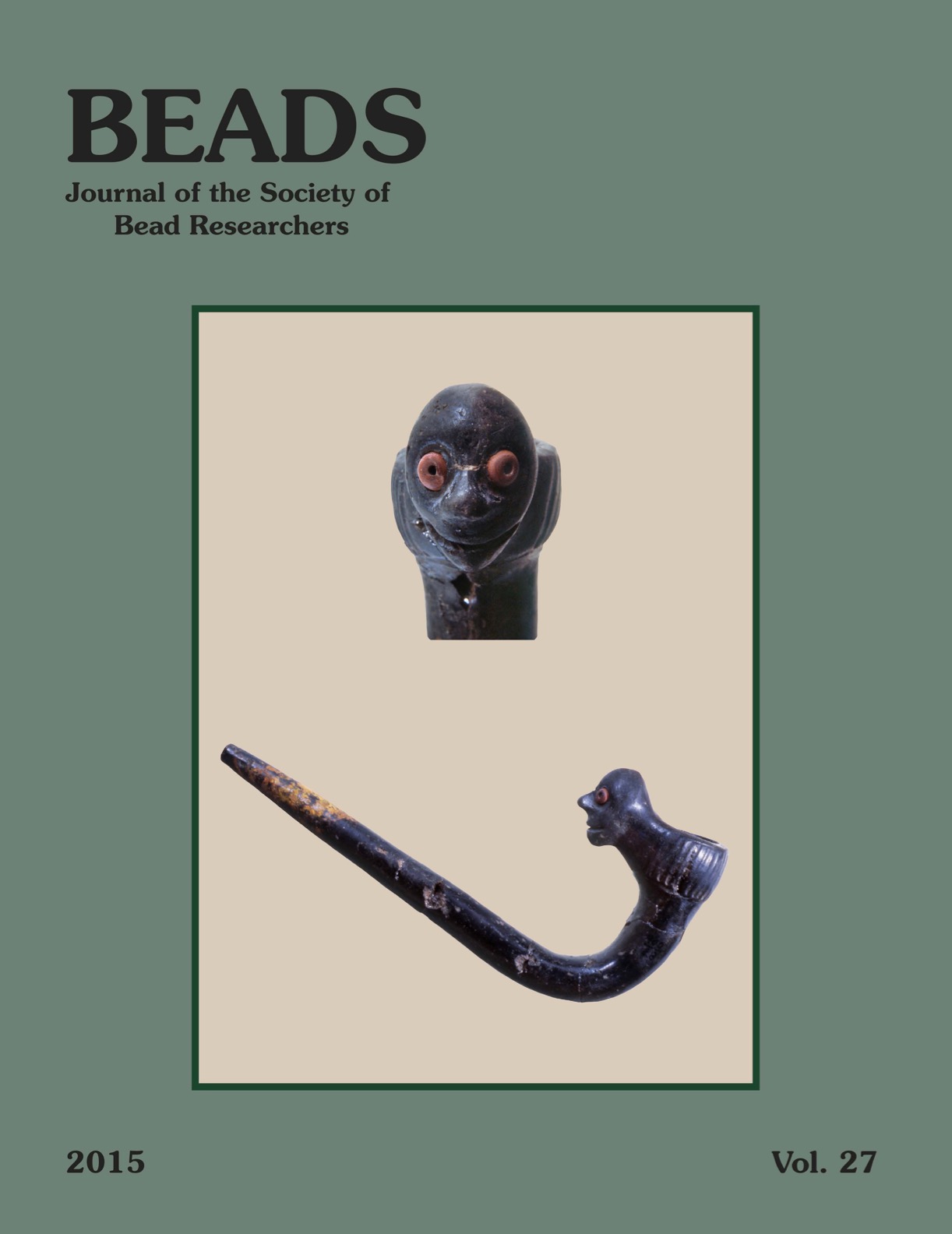
Volume 27 cover image

Issue description

Beads is published annually by the Society of Bead Researchers, a non-profit, scientific-educational organization which aims to foster serious research on beads of all materials and periods, and to expedite the dissemination of the resultant knowledge. Subscription is by membership in the Society. Membership is open to all persons involved in the study of beads, as well as those interested in keeping abreast of current trends in bead research.

Articles

  1. Ceramics and Glass Beads as Symbolic Mixed Media in Colonial Native North America

    During the 17th and 18th centuries, Native Americans rarely adorned ceramic objects with glass beads, despite the millions of beads introduced by Europeans through trade. Bead-decorated ceramics have been reported from only nine sites in North America, perhaps due to a tendency for archaeologists to overlook or misclassify bead-inlaid pottery. The 40 artifacts represent widely divergent ethnic groups separated from each other culturally, as well as by great distances in space and time. Yet they display a remarkable consistency in the pattern of bead arrangement and use of color. Colored glass beads stand in for human eyes in effigy smoking pipes and white beads encircle the mouths of pottery vessels. Rather than examples of idiosyncratic coincidence, crafters of these objects communicated broadly shared ideological metaphors. These rare artifacts speak to the interconnectedness of ancient Native Americans and to related worldviews developed over centuries of intercommunication involving mutually intelligible symbolic metaphors.

  2. A 17th-Century Glass Bead Factory at Hammersmith Embankment, London, England

    Excavations in 2001 and 2005 at Hammersmith Embankment in West London uncovered the remains of two glass furnaces with associated wasters relating to the manufacture of drawn glass beads during the second quarter of the 17th century. The site is significant as it represents the first archaeological evidence for the production of glass beads in post-medieval England. A preliminary study of the recovered material reveals the presence of 43 different bead varieties, many with stripes and multiple layers. While a number have not yet been observed elsewhere, a few have correlatives at a contemporary bead production site in Amsterdam, as well as aboriginal sites in northeastern North America. Comparisons of the chemical compositions of the Hammersmith beads with those of beads from the Amsterdam factory and other loci reveal a number of similarities as well as differences indicating that it will be difficult to identify Hammersmith beads at other sites around the world.

  3. Pipeclay Beads from Norton St Philip, England

    In 17th-century England, the village of Norton St Philip was well known as a center for the manufacture of clay tobacco pipes. In recent years, however, discoveries have shown that pipes were not the only things they made, as among a variety of interesting objects are some quite remarkable beads.

  4. Beads and Pendants from Sedeinga, Nubia

    Excavations conducted during the 2009-2014 seasons at the burial site of Sedeinga, Nubia, produced 3,400 beads and pendants of various materials which date to the Late Napatan and Meroitic periods, ca. 400 B.C.-A.D. 300. The chronological, geographical, and political situation of the site made the bead assemblage exceptionally rich in organic and inorganic materials as well as the technologies used to make the objects. During a period dominated by faience and glass in bead production, the use of organics and stones indicates strong links with the neighboring Nubian deserts, an overland connection with the Red Sea coast, and, surprisingly, an interest in the resources of the Nile River. A preliminary assessment of the beads provides more specific evidence to help date some of the Sedeinga tombs. Furthermore, due to known parallels, a few Sedeinga bead types can be associated with specific age groups.

  5. Elite Dress and Regional Identity: Chimú-Inka Perforated Ornaments from Samanco, Nepeña Valley, Coastal Peru

    This article addresses two central components of the study of perforated ornaments recovered from archaeological contexts: 1) the explication and analysis of the relationship between perforated ornaments and identity production, and 2) the collection of data specific to perforated ornaments. By comparing perforated ornaments from the Chimú-Inka period (ca. 1470-1532) elite tomb at Samanco, Peru, to those from other sites, patterns in the use of perforated ornaments in identity negotiation may be identified and assessed. We demonstrate that perforated ornaments were deployed to demonstrate local, regional, and imperial identities, though in an ambiguous way that could have been mis- or reinterpreted. Although a central component of the assessment of identity negotiation involves comparison with perforated ornaments from other sites, this study is limited because they are rarely described in detail. In an effort to remedy this situation, we provide detailed methods and results as baselines for future comparison.