Skip to main navigation menu Skip to main content Skip to site footer

Volume 26

DOI: https://doi.org/10.7264/03p0ta64

Published January 1, 2014

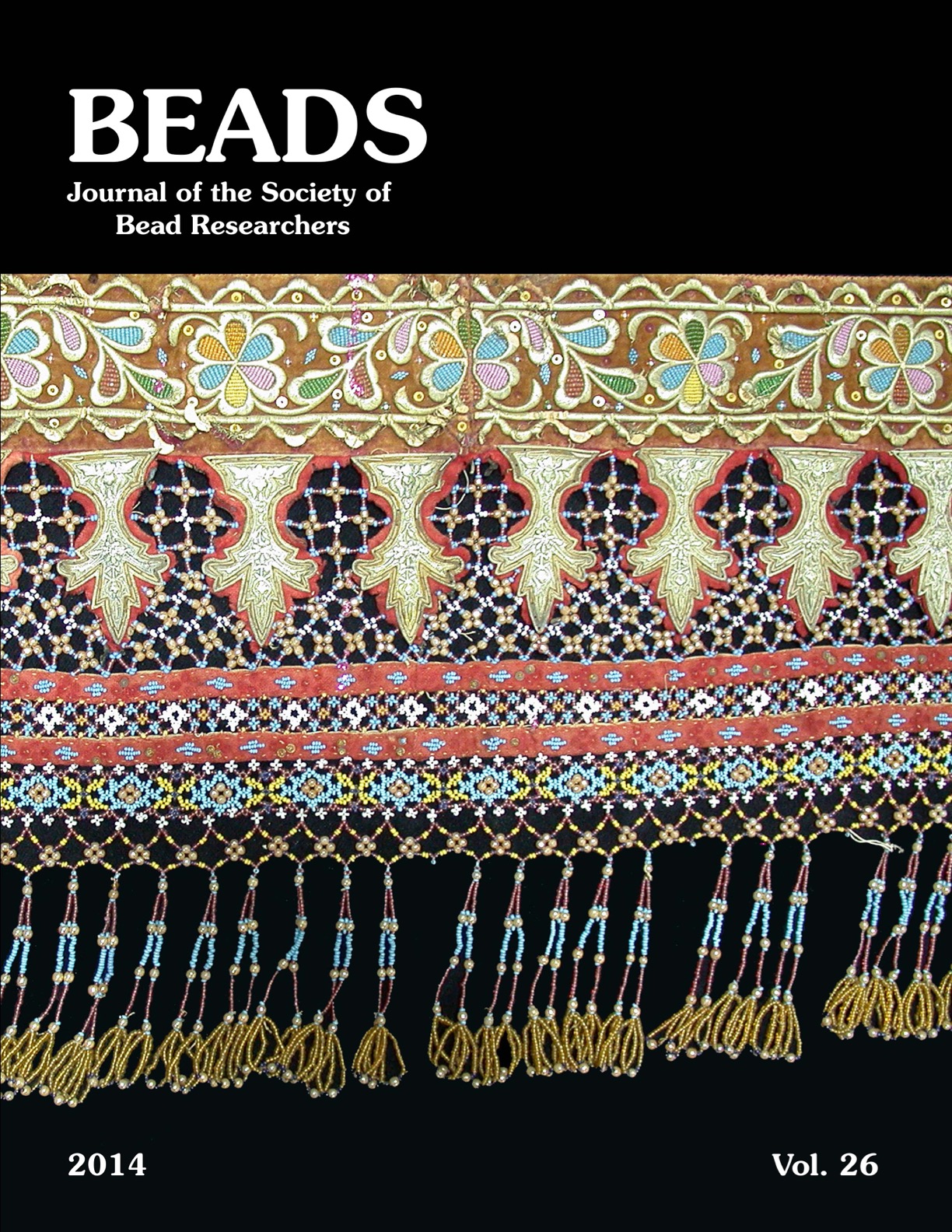
Volume 26 cover image

Issue description

Beads is published annually by the Society of Bead Researchers, a non-profit scientific-educational organization which aims to foster serious research on beads and beadwork of all materials and periods, and to expedite the dissemination of the resultant knowledge. Subscription is by membership in the Society. Membership is open to all persons involved in the study of beads, as well as those interested in keeping abreast of current trends in bead research.

Articles

  1. Glass Beads from Jar Burials of the 15th-17th Centuries in the Cardamom Mountains of Cambodia

    A variety of glass beads were encountered in jar burials dating to the 15th-17th centuries found on rock ledges in remote portions of the Cardamom Mountains in southern Cambodia. These burials represent a mortuary ritual in which defleshed bones, often from multiple individuals, were deposited in large ceramic jars predominantly from Thai kilns. Despite the isolated location, the jars and glass beads suggest that the people buried in the jars were active participants in exchange networks. The identification of different compositional types of glass beads can be related to possible trade networks with the lowlands and maritime Southeast Asia. Using ethnographic analogies with other upland communities in Southeast Asia, the authors also propose that the placement of beads in the jar burials may have been an important part of the mortuary ritual of the Cardamom Mountain people.

  2. Shell and Glass Beads from the Tombs of Kindoki, Mbanza Nsundi, Lower Congo

    The ancient Kingdom of Kongo originated in Central Africa in the 14th century. In the 15th century, the Portuguese organized tight contacts with the Bakongo. From then on European goods gained new significance in the local culture and even found their way into funerary rites. Among the most important grave goods in the Kingdom of Kongo were shell and glass beads. They occur in many tombs and symbolize wealth, status, or femininity. At the burial site of Kindoki, linked with the former capital of Kongo's Nsundi province, a great number of shell and glass beads were found together with symbols of power in tombs attributed to the first half of the 19th century. Determining the origin of these beads and their use in the Kongo Kingdom leads to interesting insights into the social and economic organization of the old Bakongo society, their beliefs, and the symbolic meaning of the beads.

  3. Archaeometrical Analysis of Glass Beads: Potential, Limitations, and Results

    Over the past few decades, several new analytical techniques have been used to determine the composition and the likely production centers of glass beads found at archaeological sites around the world. Made since antiquity, glass beads are important artifacts which can provide much more information than their small size suggests. This article reviews the most common analytical techniques used to study glass beads - optical microscopy, scanning electron microscopy (SEM), x-ray fluorescence (XRF), instrumental neutron activation analysis (INAA), laser ablation inductively coupled plasma mass spectrometry (LA-ICP-MS), and Raman spectroscopy - and discusses their potential, limitations, and what results may be expected.

  4. Glass Beads from Champlain's Habitation on Saint Croix Island, Maine, 1604-1613

    One of the earliest French attempts at settlement in northeastern North America occurred on a small island in the St. Croix River along the Maine/New Brunswick border. Built under the auspices of Pierre Dugua, Sieur de Mons, and his young lieutenant, Samuel de Champlain, this settlement barely survived the winter of 1604-1605 and was abandoned the following summer. Given its clear historical association and brief occupation, the glass beads from St. Croix Island are an important archaeological marker for reconstructing French influence during the first decades of the 17th century. Knowing who used these beads in trade, however, does not indicate where they were made. Current evidence suggests that many, and perhaps most, of these beads were produced at the Carel-Soop glasshouse in Amsterdam (1601-1624) and are a material expression of the culturally diverse partnerships that sponsored many of the early-17th- century voyages to Terra Nova.

  5. From the Past (1854): A Chapter on Necklaces, Old and New

    Originally published in Godey's Magazine and Lady's Book in 1854 (pp. 213-216), this article presents a brief history of necklaces among the classic Egyptians, Greeks, and Romans, as well as the British, from the perspective of an educated English lady. It is an instructive early study of strung adornments based on antiquarian, historical, and literary sources.