Skip to main navigation menu Skip to main content Skip to site footer

Volume 25

DOI: https://doi.org/10.7264/1de14t02

Published January 1, 2013

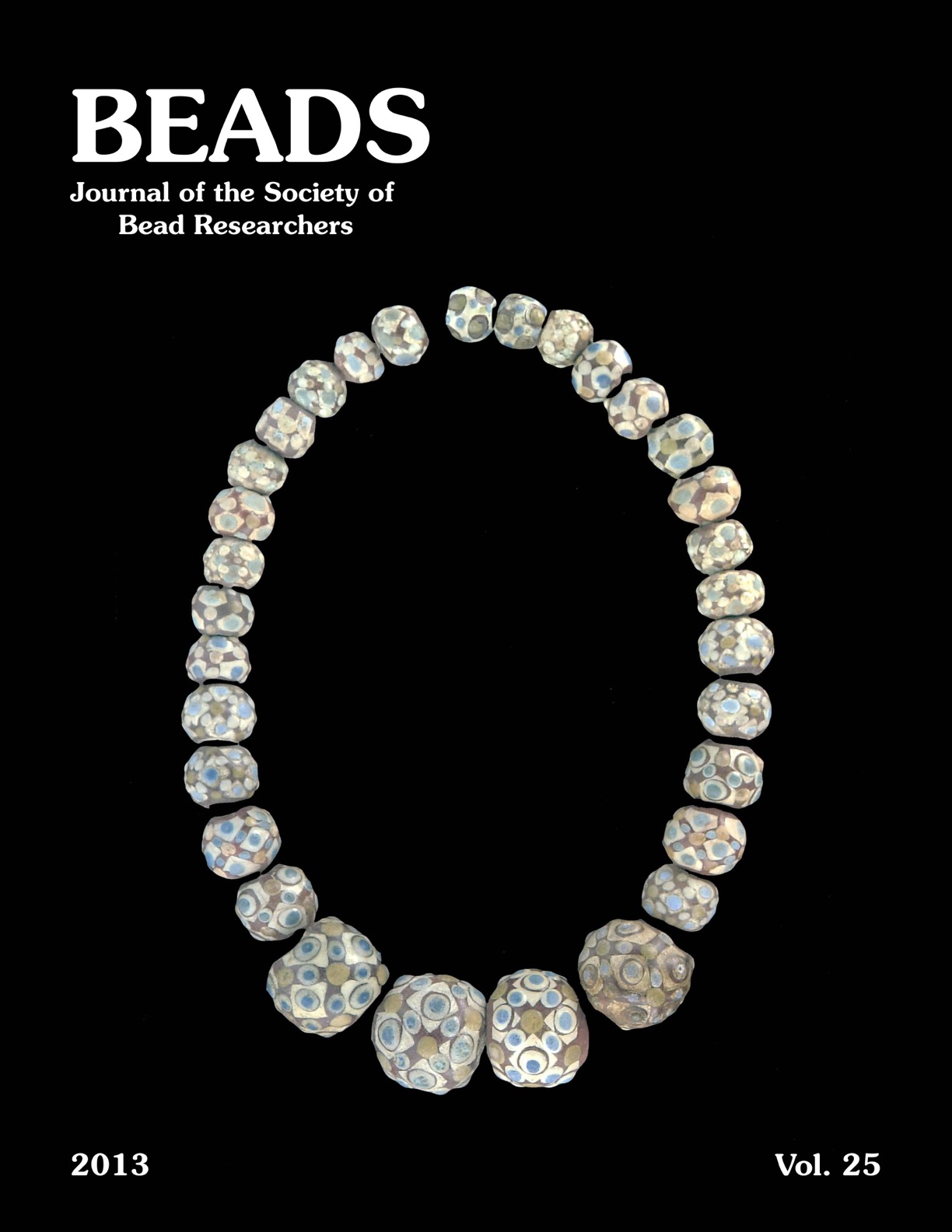
Volume 25 cover image

Issue description

Beads is published annually by the Society of Bead Researchers, a non-profit scientific-educational organization which aims to foster serious research on beads and beadwork of all materials and periods, and to expedite the dissemination of the resultant knowledge. Subscription is by membership in the Society. Membership is open to all persons involved in the study of beads, as well as those interested in keeping abreast of current trends in bead research.

Articles

  1. Early Chinese Faience and Glass Beads and Pendants

    The earliest Chinese beads and pendants were composed of faience and appeared during the early Western Zhou period, around the 11th Century B.C. True glass began to be made about the time of the Spring and Autumn period (771-467 B.C.). An amazing variety of beautiful "dragonfly-eye beads" appeared in China during the Warring States period (475-221 B.C.), but these were imported and not local products. The complex eye beads were replaced during the Han dynasty (206 B.C.-A.D. 220) by small, plain glass beads generally intended to be strung together. Perforated glass ear spools were also popular during this period and were sometimes adorned with bead strands. Small glass stringing beads as well as other forms continued in use in subsequent dynasties, as did various types of pendants. During the Ming dynasty (1368-1644), glass was used to produce beautiful imitation jade objects including fanciful compound pendants. These were often finely carved and exhibit a high level of craftsmanship.

  2. Chinese Bead Curtains, Past and Present

    Relatively little is known about how beads were combined to form larger structures in China. To address this situation, this paper focuses on Chinese bead curtains. Adopting an approach that is broad rather than deep and empirical rather than theoretical, it collates evidence from the textual, material, oral, and pictorial records to consider bead curtains from various perspectives. To begin, this study defines bead curtains as textiles, door and window ornaments, screens, and types of beadwork. It then discusses bead curtains of the imperial era (221 B.C.-A.D. 1911) as they are referenced in the Chinese textual record from the 4th century on. A discussion of bead curtains of the post-imperial era (1912-present) follows, offering a small database of 20th- and 21st-centuries examples composed of organic and inorganic bead materials. While contemporary, commercially-produced Chinese bead curtains are mentioned in passing, they are not the focus of this article. Nor are bead-embellished valances addressed. As further research is undertaken, it should be possible to refine or revise the information offered here.

  3. Beads from the Hudson's Bay Company's Principal Depot, York Factory, Manitoba, Canada

    There is no other North American fur trade establishment whose longevity and historical significance can rival that of York Factory. Located in northern Manitoba, Canada, at the base of Hudson Bay, it was the Hudson's Bay Company's principal Bay-side trading post and depot for over 250 years. The existing site of York Factory is the last of a series of three posts, the first of which was erected in 1684. Completed in 1792, York Factory III functioned as the principal depot and administrative center for the great Northern Department until the 1860s when its importance began to wane. It then entered a long period of decline which ended in 1957, when the post was finally closed. Subsequent archaeological work at the site has revealed many structural features and associated artifacts including a large and varied assemblage of beads, mostly glass, which are the subject of this report.