Skip to main navigation menu Skip to main content Skip to site footer

Volume 22

DOI: https://doi.org/10.7264/fc1act86

Published January 1, 2010

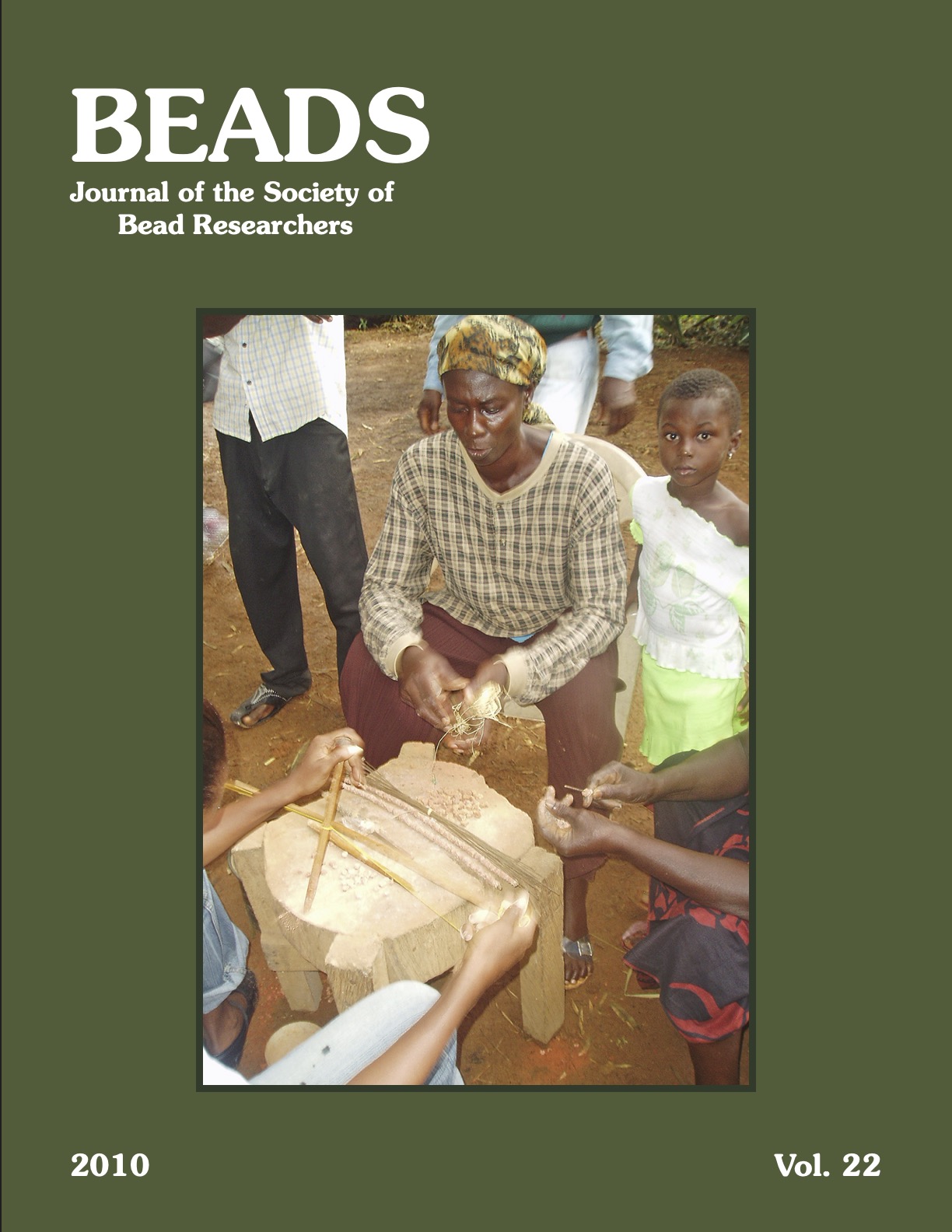
Volume 22 cover

Issue description

Beads is published annually by the Society of Bead Researchers, a non-profit scientific-educational organization which aims to foster serious research on beads and beadwork of all materials and periods, and to expedite the dissemination of the resultant knowledge. Subscription is by membership in the Society. Membership is open to all persons involved in the study of beads, as well as those interested in keeping abreast of current trends in bead research.

Articles

  1. Bauxite Mining and Bead Production in Ghana

    Abompe is the current bauxite beadmaking site in Ghana and the hills of the Kwahu Plateau above the village are pocked with hundreds, perhaps thousands, of pits dug in search of the raw material. To determine the age of the beadmaking industry in the region, people in Abompe and other villages were interviewed and related stories that suggest the first beadmakers were following the example of people in or around Bepong, a village on the plateau above Abompe. Three areas of bauxite pits on the Kwahu Plateau were investigated to see if there was physical evidence of ancient mining; those currently used by Abompe people and those previously dug by Bepong and Adasowase people. Four boulders with polished upper surfaces were found in the Abompe mining area and are believed to represent large-scale bead polishing. Caves where miners occasionally stay overnight were explored and evidence of bead production in the form of chipping waste was found. Pit counts by transect at Odumparara Bepo, the Abompe mining area, suggest the presence of possibly as many as 4,700 pits. These appear to have been created in the past 100 years.

  2. Sixteenth-Century Glass Beads from Chotuna, North Coast of Peru

    Burials excavated on the north coast of Peru were associated with 16th-century European glass beads as well as shell and stone specimens of local manufacture. The beads were strung as necklaces, bracelets, and anklets, often combining several varieties of European beads with local products. The glass beads as well as the other grave goods suggest that the burials date to the first part of the 16th century, probably between 1530 and 1560.

  3. Lucayan Beads from San Salvador, Bahamas (ca. A.D. 900-1500)

    A variety of Lucayan shell, stone, and coral beads as well as beadmaking waste was recovered from several sites on San Salvador, Bahamas. Following detailed analysis, comparisons to other beadmaking sites in the Greater Caribbean region indicate that fabrication, material, color preference, and even general forms are similar across great distances from the Maya region to the Greater and Lesser Antilles and the Bahamian Archipelago. In some cases, beads appear to have been made at the household level (Middle Pre-Classic Maya, Post Saladoid Lucayans), although certain stratified societies (later Maya, Classic Taíno) seem to have exerted more control or monopoly over bead manufacturing at various times. The beads were predominately white and red in color. Color symbolism suggests that white (or shiny) beads were more preferred and associated with peace, the "celestial complex," gold and silver, the sun and moon, and elite status. Red seems to have been associated with war, the agricultural complex, blood and fertility, the soil and earth, and lower social status. Appreciation of these Lucayan beads includes their beauty, simplicity, symbolism, and the laborious nature of their fabrication, it taking some two months to produce a single strand of a few hundred beads for a single wearer.

  4. Venetian Glass Beads and the Slave Trade from Liverpool, 1750-1800

    The competition within the slave trade during the 18th century forced slave traders to search for an assortment of barter cargo that would attract the preferential attention of the African suppliers of slaves. An enterprising group of Liverpool slave traders that formed William Davenport & Co. rose to the occasion and in three years became the supplier of half of all the glass beads re-exported to Africa from England. An analysis of barter values in Bonny, West Africa, reveals that glass beads were one of the main categories of trade goods of great interest to the African slave traders. The trade beads were primarily the products of Venice where the glass bead sector grew from at least 7% to over 70% in value of total Venetian glass exports from the late 16th to the late 18th century. While the sale of glassware in Venice slumped due to competition from other European producers, the bead industry prospered and manufactured tens of millions of units of conterie and perle a lume beads per year during the second half of the 18th century.