Skip to main navigation menu Skip to main content Skip to site footer

Volume 19

DOI: https://doi.org/10.7264/vvbmty71

Published January 1, 2007

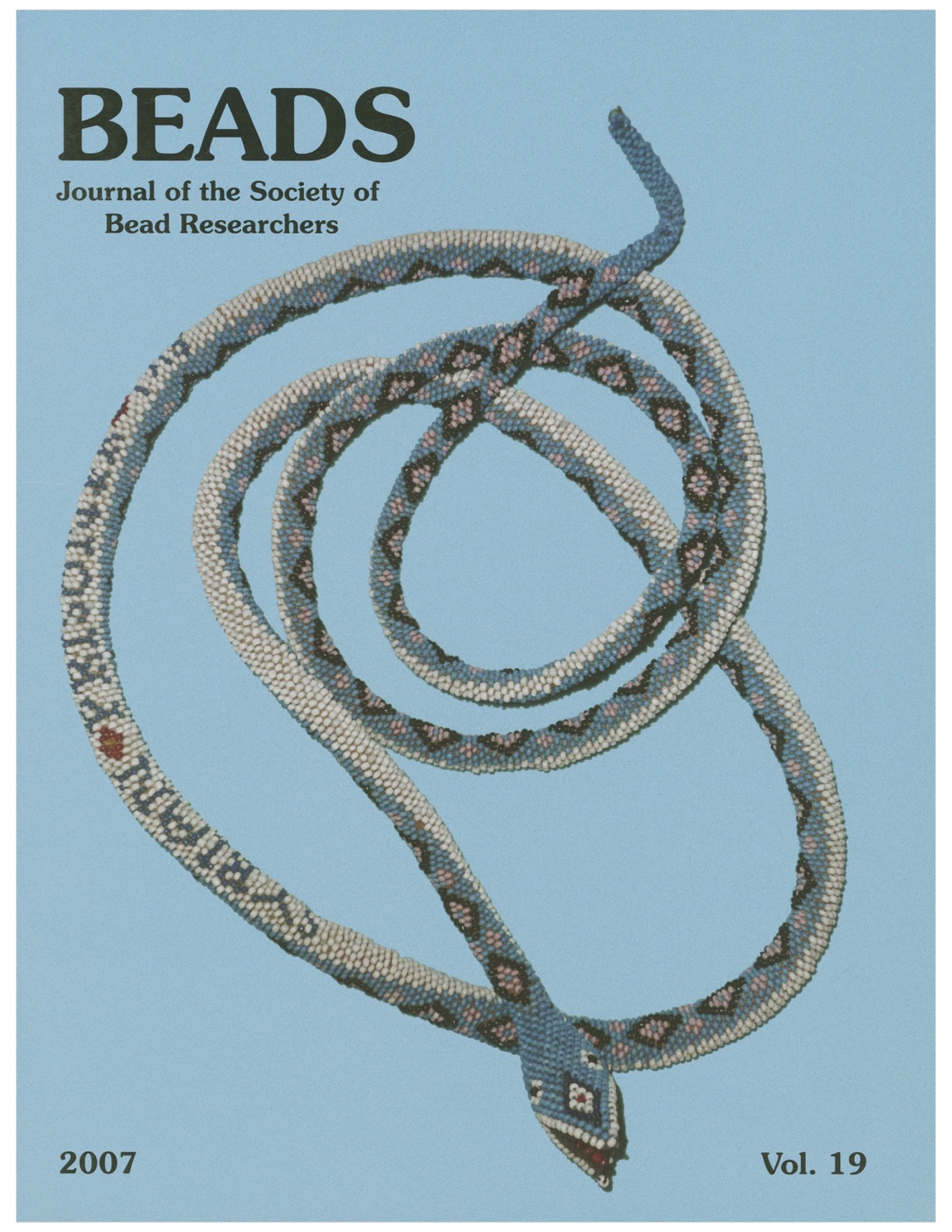
Volume 19 cover, featuring a long beaded snake.

Issue description

Beads is published annually by the Society of Bead Researchers, a non-profit scientific-educational organization which aims to foster serious research on beads and beadwork of all materials and periods, and to expedite the dissemination of the resultant knowledge. Subscription is by membership in the Society. Membership is open to all persons involved in the study of beads, as well as those interested in keeping abreast of current trends in bead research.

Articles

  1. World War I Turkish Prisoner-of-War Beadwork

    Drawing on the rich tradition of textile crafts in the Ottoman Empire, Turkish soldiers incarcerated in British prison camps in the Middle East during and immediately after World War I made a variety of beadwork items to relieve the boredom of their prolonged imprisonment and to barter or sell for food and other amenities. Best known are the bead crochet snakes and lizards, but the prisoners also used loomed and netting techniques to produce necklaces, belts, purses, and other small items.

  2. Eighteenth-Century Glass Beads from the English Slaving Fort at Bunce Island, Sierra Leone

    While countless tons of European glass beads flowed into West Africa over the centuries, there is still relatively little information concerning what specific nations were importing over time. It was therefore of great interest to learn about two collections of beads surface collected at the site of a British slaving fort that operated on Bunce Island in the Sierra Leone estuary of coastal Sierra Leone from the late 17th to the early 19th century. Although it is impossible to assign the beads to a specific period in the fort's history, it is clear that they are of 18th-century origin and were part of the goods traded by the British. The present study describes the small but diverse collection of beads and places them in historical context.

  3. An Archaeological Approach to Understanding the Meaning of Beads Using the Example of Korean National Treasure 634, A Bead from a 5th/6th-Century Royal Silla Tomb

    An ancient bead is a document from the past—a message in a bottle—written in some lost symbolic language. Archaeologists try to understand that language by integrating scientific and technological approaches with the social, economic, political, and symbolic/ religious context in which the bead was found. As an example, we use Korean National Treasure 634 (NT634), a dark blue glass bead adorned with mosaic decorations of a bird, a flowering tree, and a human face, found in a 5th-6th century Korean tomb. This bead suggests its meaning by how and where it was made, and what its images may represent.

  4. Western Indian (Mewar) Chalcolithic Beads with Special Reference to Balathal

    During the last few years, Indian archaeologists have concentrated their efforts on the investigation of sites of the 3rd to 2nd millennia B.C. in the Mewar region of western India. Unfortunately, most of the excavations have been focused on understanding the cultural sequence, settlement patterns, architecture, and pottery at the sites and have neglected the study of such important artifact categories as beads. As no final reports have been published and the excavations have been carried out by different agencies, reconstructing the bead culture of this area is very difficult. We know quite a bit about the beads of the urban Harappans but know practically nothing about those used by the contemporary rural Chalcolithic people. This paper discusses the beads recovered from a number of Chalcolithic sites, with emphasis on the oldest village in India—Balathal.

  5. Chemical Composition of Late 18th- and 19th-Century Glass Beads from Western North America: Clues to Sourcing Beads

    The Sullivans Island glass bead collection at the Smithsonian's National Museum of Natural History contains over 56,000 beads which date from the late 18th to the late 19th century. Excavated in the 1930s from a site on the Columbia River in the Plateau region of North America, this collection contains examples of most known bead varieties for this time period. Many of the beads conform to varieties that have been attributed to Bohemia, Venice, and China-three of the main bead-producing centers for this time period. One hundred and twenty-four beads were subjected to Laser-Ablation Inductively-Coupled Mass-Spectrometry (LA-ICP-MS) analysis at the Smithsonian's Materials Conservation Institute to see if the chemical composition of the glass could be correlated with a place of origin. The results revealed several distinct compositional groups, some of which could be linked to geographical areas.