Skip to main navigation menu Skip to main content Skip to site footer

Volume 17

DOI: https://doi.org/10.7264/p50s5654

Published July 25, 2005

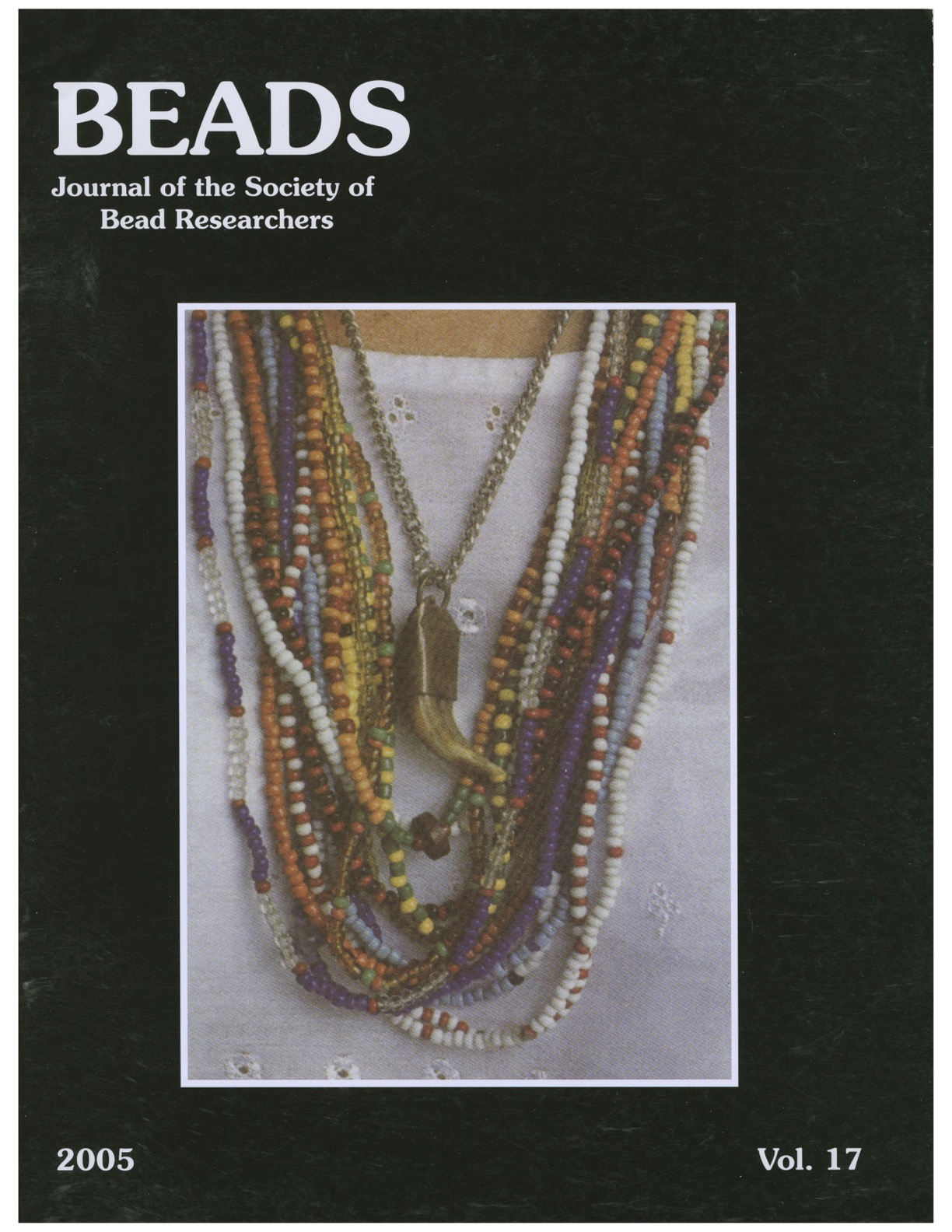
Volume 17 cover, a close up on a person wearing 10-20 beaded necklaces.

Issue description

Beads is published annually by the Society of Bead Researchers, a non-profit scientific-educational organization which aims to foster serious research on beads and beadwork of all materials and periods, and to expedite the dissemination of the resultant knowledge. Subscription is by membership in the Society. Membership is open to all persons involved in the study of beads, as well as those interested in keeping abreast of current trends in bead research.

Articles

  1. Necklaces Used in the Santería of Cuba

    This article examines the necklaces used in the Afro-Cuban Rule of Orisha, more commonly known as Santería. This religion, created by African slaves brought to Cuba starting in the 16th century, combines aspects of Yoruba orisha worship and Spanish Catholicism. It allowed African religious beliefs and practices to survive despite the imposition of Catholic doctrine. One of the outcomes of this amalgamation is the practice of associating individual orishas (deities) with certain Catholic saints. Each orisha is represented by specific necklaces that incorporate particular bead forms, colors, and numbers.

  2. Die Perle: A 1920s German Trade Journal

    Though short lived, the German trade journal, Die Perle, contains a wealth of information concerning the European bead and jewelry industry of the 1920s. Short articles provide insight into new machinery and apparatus for producing beads, natural and artificial materials for the production of beads and other ornaments, fashion trends, market reports, and numerous other topics. As well, there are several departments which deal with specific themes such as technical questions and sources of supplies. As the journals are in German, English summaries are provided for a representative sample of the articles to give the reader an idea of their vast scope.

  3. Late 19th- and Early 20th-Century Manufacture of Drawn Glass Tubing for Glass Beads

    Late 19th- and early 20th-century archaeological sites often contain machine-made drawn glass beads with unique shapes and perforations. Little information exists documenting when these beads were initially manufactured. Through an examination of hundreds of U.S. patents, it appears that the mechanized production of drawn beads could have occurred as early as the late 19th-century, but more likely, they were not mass produced until the end of World War I, after the invention of the Danner process for mechanically drawing glass tubing. Machine-made drawn beads with multiple sides and/or shaped perforations also appear to have been produced by the late-19th century, but again, mass production probably did not occur until around the end of World War I.

  4. Elemental Analyses of North American Glass Trade Beads

    Although European-made glass trade beads can be sorted into bead varieties and studied in that manner on the basis of physical attributes, much more information can be obtained about them by means of chemical analysis. Such analyses produce chemical fingerprints that may be compared and grouped. Bead varieties that have matching chemistries were made using the same ingredients that probably came from the same sources, suggesting that they were made in a specific manufacturing center and probably during the same approximate time period. Using this information may help to establish with which European nationals specific indigenous people were dealing and may perhaps even link archaeologically recovered beads to the European beadmaking houses from whence they came.

  5. Thirteen-Hundred-Year-Old Bead Adornments from Baar, Canton Zug, Switzerland

    In the year 2000, an Early Medieval (7th-century) cemetery containing more than 200 burials with rich grave goods was discovered in Baar, Canton Zug, Switzerland. Thanks to the painstaking methods used in the excavation and recording of the 2,985 glass, amber, coral, and amethyst beads found with the female burials, it was possible to reconstruct the necklaces and sewn-on appliqués they were part of. Comparisons with mosaic depictions of famous women—such as the Empress Theodora in San Vitale in Ravenna, Italy—suggest that the people of Baar imitated southern Alpine Byzantine bead jewelry fashion.