Skip to main navigation menu Skip to main content Skip to site footer

Volume 14

DOI: https://doi.org/10.7264/peqx1b79

Published January 1, 2002

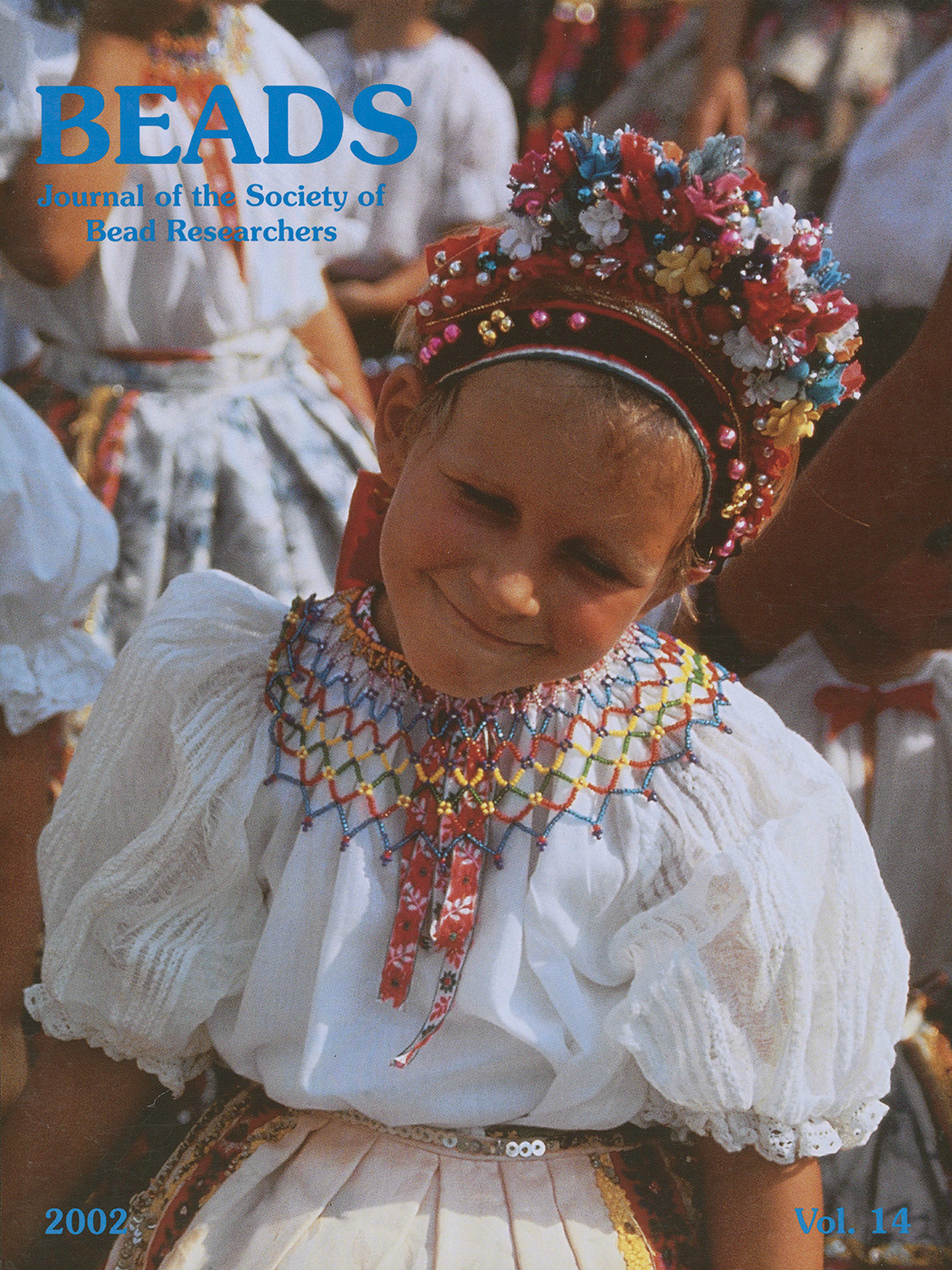
Cover of Volume 14 of BEADS

Issue description

BEADS is published annually by the Society of Bead Researchers, a professional non-profit corporation which aims to foster serious research on beads ofall materials and periods, and to expedite the dissemination of the resultant knowledge. Subscription is by membership in the Society. Membership is open to all persons involved in the study of beads, as well as those interested in keeping abreast of current trends in bead research.

Articles

  1. Beadwork of Hungary and Transylvania

    Beading is a cultural necessity in some rural villages of Hungary and Transylvania, where peasants have used embroidery and beads to lavishly embellish their costumes for hundreds of years. Remaining little changed over several centuries and almost oblivious to beads and beadwork in the rest of the world, the peasants of these villages have slowly evolved their own style of beadwork from thread embroidery and other embellishing methods. Based on field research, this article explores the cultural traditions, rich designs, and techniques of beadwork in four Hungarian villages—three in Transylvania (Romania) and one in southern Hungary.

  2. A Brief Biography of Giovanni Giacomuzzi: Artist and Glassmaker

    Giovanni Giacomuzzi (1817-1872) was the driving force behind the celebrated 19th-century Venetian beadmaking and glassworking firm of Fratelli Giacomuzzi fu Angelo, one of whose bead sample books is described in the accompanying report. This tribute by a learned contemporary summarizes Giacomuzzi's accomplishments and sheds light on the life of a much-honored master glassworker.

  3. The Giacomuzzi Bead Sample Book and Folders

    The sample book described herein displays the wound glass beads produced during the third quarter of the 19th century by an acclaimed Venetian firm, that of the Giacomuzzi brothers. The book vividly shows what sorts of beads were being marketed by a single firm at this time, and provides much useful information concerning bead sizing systems. Although not marked with the producers name, the folders that accompany the book are of like date and at least one is likely a product of the Giacomuzzis.

  4. Late Neolithic Amber Beads and Pendants from the Lake Lubāns Wetlands, Latvia

    In Late Neolithic Europe, amber beads and pendants were initially mainly made in the coastal zone of the Baltic Sea, due to the presence of amber washed up by the Litorina Sea. There were four principal localized zones of Neolithic amber artifacts in this region: the eastern Baltic, the mouth of the Vistula River, Jutland and Skone, and Fennoscandinavia. The British Isles are regarded as a fifth zone. As the popular-scientific literature has so far provided scant information on the amber-working zone of the eastern Baltic, this article summarizes the findings revealed by extensive archaeological research, particularly during the past forty years.