Skip to main navigation menu Skip to main content Skip to site footer

Volume 6

Published January 1, 1994

Issue description

Beads is published annually by the Society of Bead Researchers, a non-profit scientific-educational organization which aims to foster serious research on beads and beadwork of all materials and periods, and to expedite the dissemination of the resultant knowledge. Subscription is by membership in the Society. Membership is open to all persons involved in the study of beads, as well as those interested in keeping abreast of current trends in bead research.

Articles

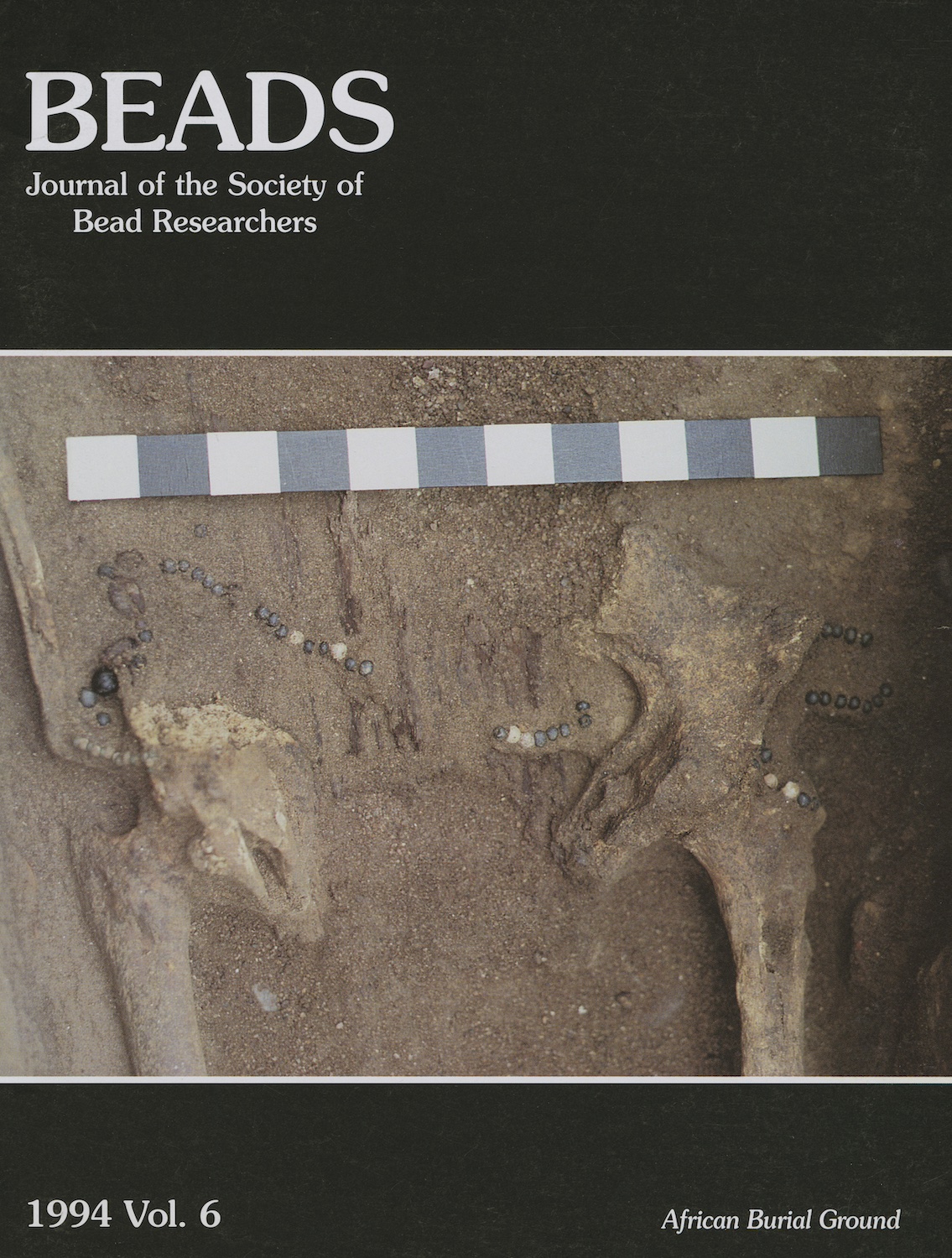
  1. Beads from the African Burial Ground, New York City: A Preliminary Assessment

    Excavation of the African Burial Ground in New York City yielded the skeletal remains of more than 400 individuals. This paper is a preliminary discussion of the beads associated with seven of the burials. The in situ bead configurations of three of the internments are distinctive and appear to be indicative of cultural practices of Africans in 18th century New York. The configurations incude necklaces and possibly wristlets, as well as waistbeads. The latter represent the first recorded instance of such use by Africans or African descendants in North America. These objects provide insight into the religious or ritual behavior of the poeple who utilized the buria ground.

  2. European Beads from Spanish-Colonial Lamanai and Tipu, Belize

    Excavation of the contact-period components of the Maya sites of Lamanai and Tipu in northern and west-central Belize, respectively, have yielded moderate collections of European glass and other beads. The archaeological data are augmented by ethnohistorical documentation regarding the length of Maya/Spanish interaction. Contexts do not provide unequivocal stratigraphic evidence of sequential bead importation, but known dates of bead varieties assist in refining both site chronology and the understanding of bead use. As the first Central American collections to be analyzed, the two assemblages offer an initial glimpse of one aspect of European impact on native material and non-material culture.

  3. A Possible Beadmaker's Kit from North America's Lake Superior Copper District

    Beads of copper are amongst the oldest and most widespread ornaments known in North America. Native copper was an important material to prehistoric Americans, and certainly the most important metal. It was collected, transported and traded over wide areas as early as 7000 years before present, and its use for ornaments persisted until it was gradually replaced by European metals over the many years of the contact period. A recently discovered cache of copper beads, bead preforms, awls, a crescent knife and scraps of raw copper at site 20KE20 in northern Michigan offers insight into the process of copper-bead production in 5th-century North America.

  4. Toward a Social History of Beadmakers

    An understanding of beads requires an understanding of the people involved with them. This paper examines three historical aspects of people engaged in beadmaking, especially the production of glass beads. The history of their social relations is considered in regards to the record of their physical movements, the manner in which they organize themselves and pass on their traditions, and their status within society. Information concerning each of these is arranged geographically and chronologically in an attempt to discern the patterns of the social history of beadmakers.