Skip to main navigation menu Skip to main content Skip to site footer

Volume 5

Published January 1, 1993

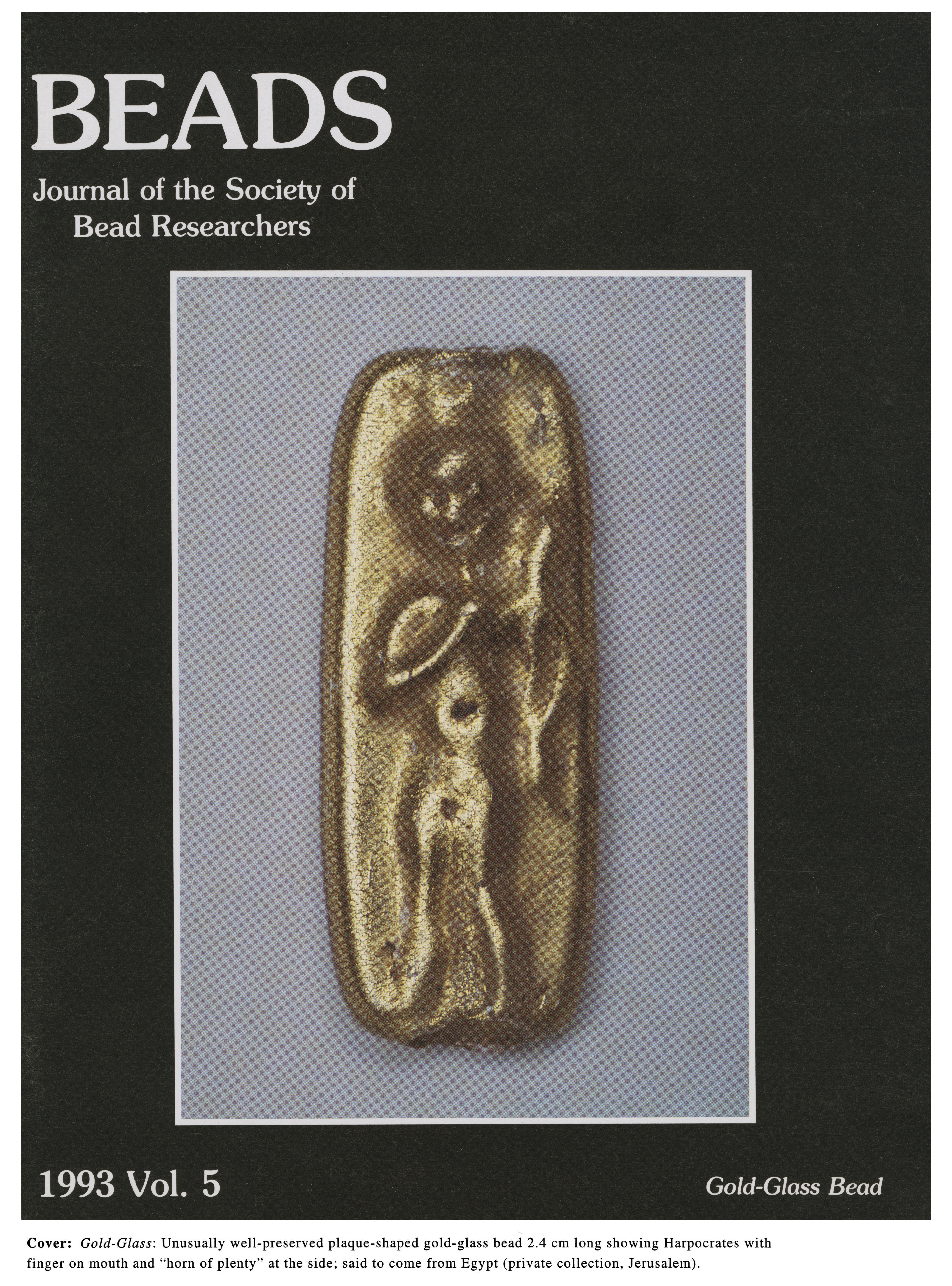
Volume 5 Cover Image

Issue description

Beads is published annually by the Society of Bead Researchers, a non-profit scientific-educational organization which aims to foster serious research on beads and beadwork of all materials and periods, and to expedite the dissemination of the resultant knowledge. Subscription is by membership in the Society. Membership is open to all persons involved in the study of beads, as well as those interested in keeping abreast of current trends in bead research.

Articles

  1. Gold-Glass Beads: A Review of the Evidence

    The study of gold-glass beads was given a considerable boost in the 1970s by Weinberg's report on their manufacture in Hellenistic Rhodes and by Alekseeva's and Boon's studies on finds from southern Russia and Britain, respectively. Nothing comparable has been published in the intervening years, but scattered new information has appeared. This paper aims to survey and review the available data on manufacturing technique, style, provenience and chronology. An attempt is also made to fit gold-glass beads into the general framework of glass history. The main focus is on the finds of the Mediterranean and related regions in pre-Islamic times. Note is taken of the continuation of the use of gold-glass beads in Medieval Europe. Conclusions drawn are usually only tentative - if not hypothetical - as sufficiently well-documented source material is scarce.

  2. The A Speo Method of Heat Rounding Drawn Glass Beads and its Archaeological Manifestations

    From at least the early 17th century to the latter part of the 18th century, drawn glass beads over about 4 mm in diameter were generally rounded in European glasshouses using a method called a speo by the Italians who apparently invented it. The little-known process involved mounting a number of tube segments on the tines of a multi-pronged iron implement which was then inserted in a furnace and turned until the tubes were rounded to the desired degree. Beads produced in this manner often exhibit distinctive characteristics and are easily identified in archaeological collections.

  3. Powdered-Glass Beads and Bead Trade in Mauritania

    Artisans in Kiffa and several other towns in southern Mauritania have produced a unique kind of powdered-glass bead for several generations. Commonly called "Kiffa beads," they generally copy the designs and forms of ancient beads, as well as more recent European examples. This article discusses their history, manufacture and relevance in Mauritanian culture. While production of the beads recently ceased for a time, several women have again begun to make them though the new varieties are not as inspiring as their predecessors.

  4. Lun Bawang Beads

    The Lun Bawang and related peoples of east Sarawak, west Sabah and Brunei have a long tradition of using beads for personal ornamentation and as value objects. They share in the general Borneo bead heritage, but follow their own tastes and fashions. Some Lun Bawang have started reproducing their favorite opaque beads from clay to sell as well as to wear on informal occasions. This new cottage industry brings a satisfactory income to the beadmakers, and helps to preserve their heirloom property.

Memorials