Skip to main navigation menu Skip to main content Skip to site footer

Volume 4

Published January 1, 1992

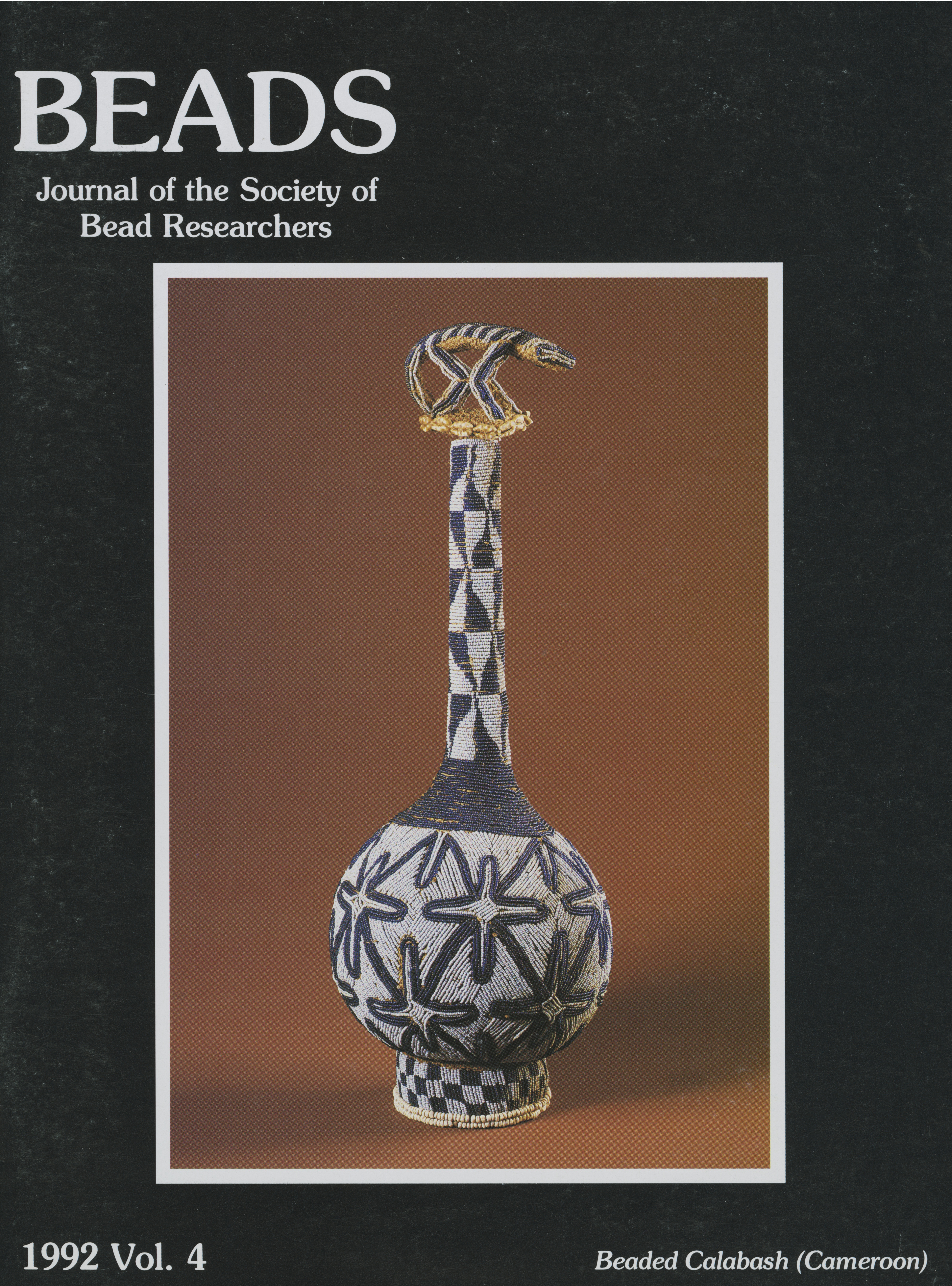
Volume 4 Cover Image

Issue description

Beads is published annually by the Society of Bead Researchers, a non-profit scientific-educational organization which aims to foster serious research on beads and beadwork of all materials and periods, and to expedite the dissemination of the resultant knowledge. Subscription is by membership in the Society. Membership is open to all persons involved in the study of beads, as well as those interested in keeping abreast of current trends in bead research.

Articles

  1. The Beads of Cameroon

    Glass beads have long played an important role in the art and culture of Cameroon, a country situated on the east side of the Gulf of Guinea in West Central Africa. This article reviews the different kinds of drawn and wound glass beads that have found broad acceptance in west-central Cameroon and discusses their diverse applications. Beads of other materials, as well as cowries and buttons, are also dealt with.

  2. The Beads of Roman and Post-Medieval Antwerpen, Belgium

    Excavations conducted at several sites in Antwerpen, a principal city and seaport on the Schelde River in northern Belgium, have uncovered a small but significant collection of glass beads. These range from a decorated specimen of the Roman period to tubular square- and star-sectioned beads of the 16th-17th centuries. The Post-Medieval specimens, found in the cesspits of merchants' homes, give us an idea of what Antwerpen was exporting during the early part of this period.

  3. On The Date of the Copper Age in the United States

    During the mid-19th century, some scholars believed that the chevron beads found in early Indian graves had been brought to North America by globe-trotting Phoenicians or representatives of some other higher European civilization. A paper on the subject published in 1862 by one of the theory's proponents is reproduced here, along with contemporary descriptions and illustrations of the beads under discussion.

  4. Identifying Beads Used in the 19th-Century Central East Africa Trade

    A wide variety of glass beads poured into Central East Africa during the second half of the 19th century as explorers, missionaries and others made their way into the uncharted interior. Each kind had a name and value that, much to the chagrin of the travelers and present-day researchers, varied from one region to another. This article synthesizes what historical documentation reveals about some of the more significant beads in the trade with an eye to identifying the actual beads that are represented.