Skip to main navigation menu Skip to main content Skip to site footer

Volume 3

Published July 25, 1991

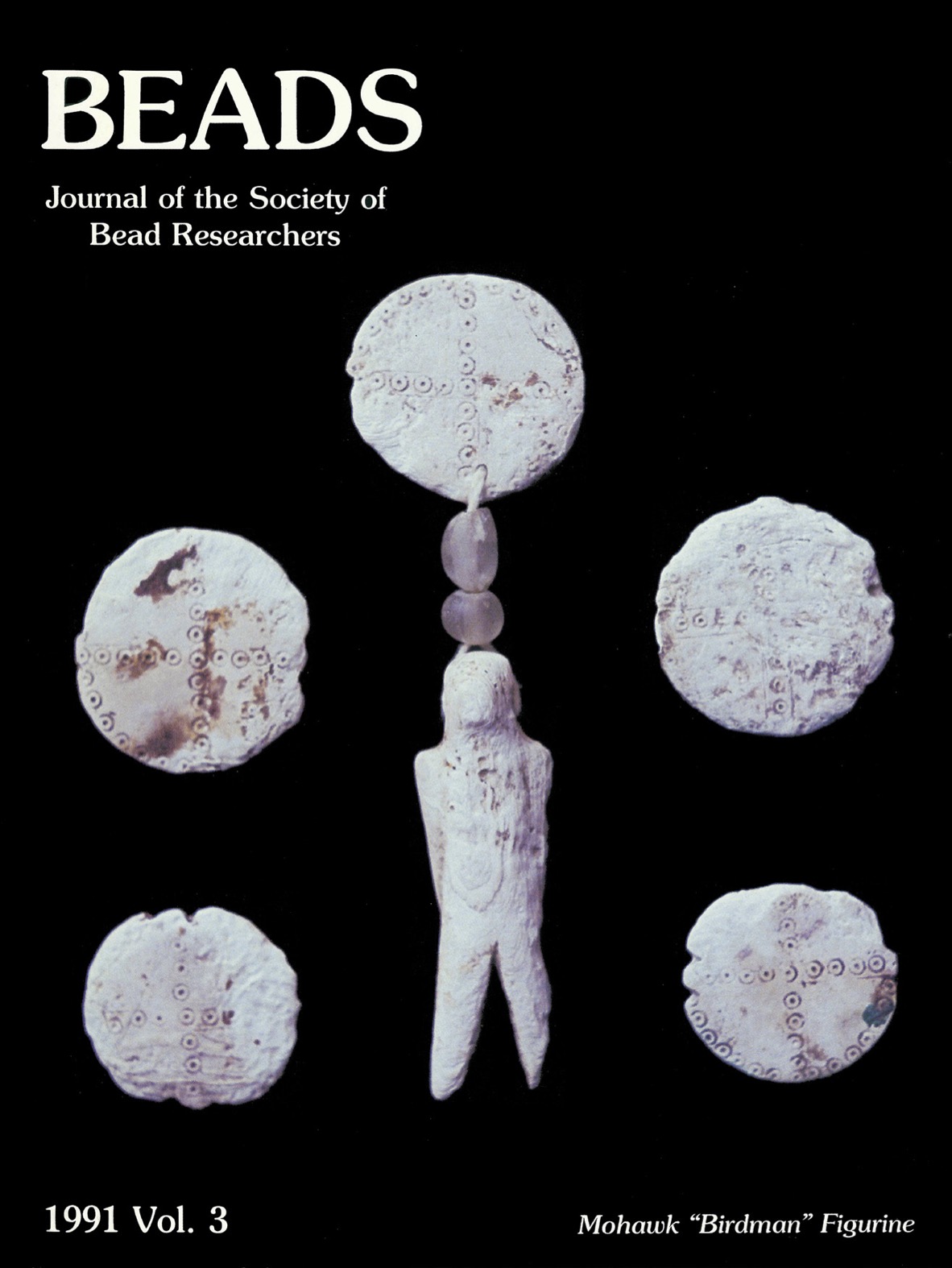
Volume 3 Cover Image

Issue description

Beads is published annually by the Society of Bead Researchers, a non-profit scientific-educational organization which aims to foster serious research on beads and beadwork of all materials and periods, and to expedite the dissemination of the resultant knowledge. Subscription is by membership in the Society. Membership is open to all persons involved in the study of beads, as well as those interested in keeping abreast of current trends in bead research.

Articles

  1. The Mohawk Glass Trade Bead Chronology: ca. 1560-1785

    Early glass beads acquired by the Mohawk Indians of New York state were a mixture of whatever was made available to them by European traders. By the second quarter of the 17th century, the beads reflected a dominance of particular types and/or colors as villages were relocated. This phenomenon appears to have ritualistic connotations and suggests that the bead-selection process was a part of the ceremonialism practiced in the daily, seasonal and annual life modes of the Mohawk. Ten distinct periods have been identified based on an examination of approximately 10,000 glass beads recovered from 33 Mohawk village sites. Other datable artifacts, historic occurrences and documents are cited to bolster the validity of using glass trade beads as a primary tool in dating the Mohawk village relocations.

  2. French Beadmaking: An Historic Perspective Emphasizing the 19th and 20th Centuries

    Beadmaking in France began in pre-Roman times. It reached its zenith in the 19th and 20th centuries when beads of sundry materials and styles were produced in both artisanal workshops and large factories to decorate a multitude of items and to serve as components of fashion jewelry. This article discusses the different beadmakers and their varied products.

  3. The Beads from Oudespost I, A Dutch East India Company Outpost, Cape, South Africa

    The site of a provisioning station operated by the Dutch East India Company near the Cape of Good Hope during the late 17th and early 18th centuries produced a variety of European beads of several materials. A "typical" Dutch bead assemblage of the period, it is significant because it comes from one of very few independently dated bead-producing sites in southern Africa and, as such, will be instrumental in the formulation of a chronology for the beads found in this part of Africa.

  4. L'Impiraressa: The Venetian Bead Stringer

    In 1893, Irene Ninni published a succinct account of a large but little-known group of Venetian women called impiraressa or bead stringers whose task it was to thread the glass beads produced on Murano and form them into hanks for the world market. The original Italian text is provided, along with an English translation. Two late 19th-century paintings by John Singer Sargent provide a rare glimpse of the bead stringers at work.