Skip to main navigation menu Skip to main content Skip to site footer

Volume 1

Published January 1, 1989

Issue description

Beads is published annually by the Society of Bead Researchers, a non-profit scientific-educational organization which aims to foster serious research on beads and beadwork of all materials and periods, and to expedite the dissemination of the resultant knowledge. Subscription is by membership in the Society. Membership is open to all persons involved in the study of beads, as well as those interested in keeping abreast of current trends in bead research.

Articles

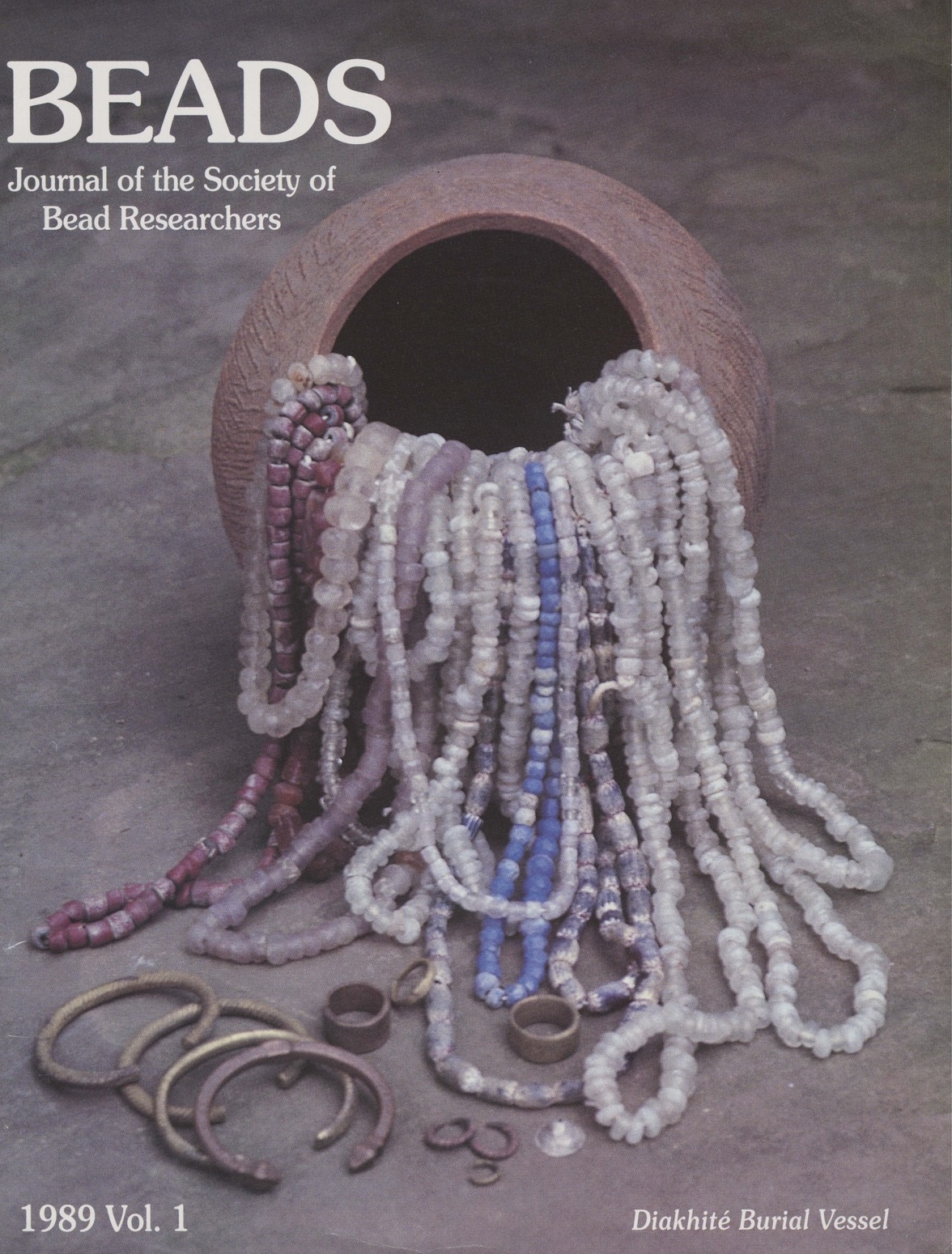
  1. Diakhité: A Study of the Beads from an 18th-19th-Century Burial Site in Senegal, West Africa

    It is the intention of this paper to place the Diakhité beads into a historical and archaeological perspective, and by so doing examine a period in Senegambian history that roughly extends from the 18th century to around the middle of the 19th century. The beads serve as a focal point to describe the trade that brought them from Europe and elsewhere to Senegambia. They also help portray some aspects of the lives of a particular ethnic group which inhabited the Thies area during this period – the Serer Nones.

  2. Beads of the Early Islamic Period

    Beads from four sites involved in Early Islamic trade (7th to 12th century) are representative of the role the Muslim world played in the Indian Ocean Bead Trade. The continuation of Classical techniques, the Islamic trade’s self-sufficiency, and the insight beads provide concerning past behavior are some of the issues explored.

  3. Beads as Chronological Indicators in West African Archaeology: A reexamination

    Drawing primarily on data obtained from recent excavations at Elmina, Ghana, this report examines the potential use of beads as temporal markers in West African archaeology. It is argued that although beads from West-African contexts are difficult to date, they provide more information than has previously been suggested. The Elmina beads are of particular interest as they can be closely dated by associated European trade materials. Preliminary results from the analysis of the 30,000 European and locally-made glass beads are discussed and findings from other West-African sites are evaluated.

  4. The Beads of St. Eustatius, Netherlands Antilles

    Archaeological excavations conducted on the Caribbean island of St. Eustatius over a seven-year period produced a wide array of 18th to early 20th-century beads of glass, coral and carnelian. Detailed descriptions of the recovered specimens are supplemented by information concerning their distribution, relative frequencies, color preference, temporal placement, origins, acquisition and use. Comparative site data are also provided.

  5. Bohemian Glass Beadmaking: Translation and Discussion of a 1913 German Technical Article

    This report provides an English translation of a German technical article on late 19th-century and early 20th-century Bohemian glass-bead manufacturing, published in 1913 in the journal Sprechsaal. The article emphasizes the description of techiques for the manufacture of mould-pressed beads, secondarily describing methods for wound, blown and drawn-bead manufacturing.

Reviews

  1.  Beads from the West African Trade Series, Vols. I-IV (1986-1988), by John Picard and Ruth Picard

    Beads from the West African Trade Series.

    Volume I, "Chevron Beads in the West African Trade," 1986. 16 pp., 8 color plates. $10.00;

    Volume II, "Tabular Beads from the West African Trade," 1986. 6 pp., 4 color plates. $5.00;

    Volume III, "Fancy Beads from the West African Trade," 1987. 16 pp., 14 color plates. $7.50;

    Volume IV, "White Hearts, Feather and Eye Beads from the West African Trade," 1988. 36 pp., 31 color plates. $15.00.

    John Picard and Ruth Picard. Picard African Imports, 9310 Los Prados, Carmel, California 93923.