Skip to main navigation menu Skip to main content Skip to site footer

Volume 7

Published January 1, 1995

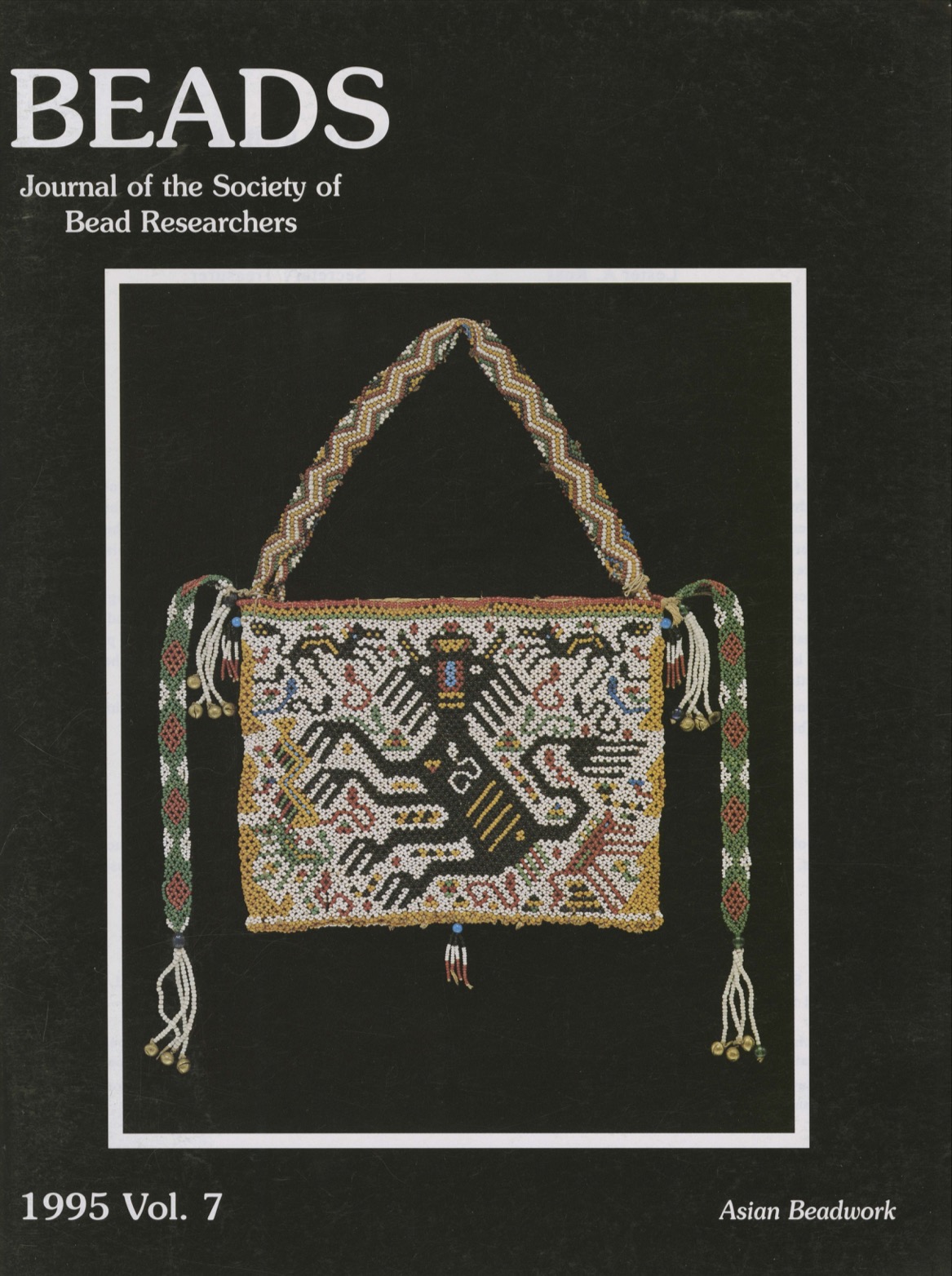
Volume 7 Cover Image

Issue description

Beads is published annually by the Society of Bead Researchers, a non-profit scientific-educational organization which aims to foster serious research on beads and beadwork of all materials and periods, and to expedite the dissemination of the resultant knowledge. Subscription is by membership in the Society. Membership is open to all persons involved in the study of beads, as well as those interested in keeping abreast of current trends in bead research.

Articles

  1. Prosperity, Reverence and Protection: An Introduction to Asian Beadwork

    Fascinating and diverse beadworking traditions have flourished in Asia for more than 1000 years, with the preponderance of surviving specimens dating to the 19th and 20th centuries. Based on a lecture presented at the Third International Bead Conference in Washington, D.C., in 1995, this article introduces Asian beadwork as a fruitful topic of inquiry for bead specialists. Representative examples produced in the last millennium by various cultures in South Asia, mainland and island Southeast Asia and East Asia are shown and discussed. Although they certainly testify to the material wealth of their makers, in many cases these pieces also carry spiritual implications. As the study of Asian beadwork is still in its infancy, it is hoped that this article will inspire others to conduct further research on the subject.

  2. Merovingian Beads on the Lower Rhine

    This paper presents a classification for beads of the Merovingian period (ca. A.D. 450-750) in the Lower Rhine region of Germany. Strings of beads recovered from graves are ordered by a seriation (correspondence analysis) which results in an ethnic (Roman vs. Frankish) and chronological structuring of the material. By comparing this with the chronological scheme established for the other archaeological finds, it becomes evident that the favored types of beads changed about every two generations. Besides changes in distinctive types, a development in general color preference is also observed.

  3. Social Status Gradations Expressed in the Beadwork Patterns of Sarawak's Orang Ulu

    The peoples of Central Borneo, known collectively as the Orang Ulu, used to display social stratification by restricting the types of ornaments an individual might use and wear. "High-ranking" motifs were the human figure, the hornbill, and the tiger or leopard. The Orang Ulu are bead connoisseurs who incorporated seed beadwork in their costume and belongings; a person could only make use of beaded items proper to his or her social stratum. Religious and social changes have democratized these once strictly aristocratic societies and their handicrafts. Today's beadworker produces not only for her own family but for the souvenir market, so she feels free to apply any designs which please the buyer.

  4. The Beads of Tenth- to Twelfth-Century Hungary

    An examination of the beads recovered from three Hungarian cemeteries in use during the 10th-12th centuries resulted in the identification of 61 distinct bead types. Seven of these were found to be significant on the basis of frequency analysis, and represent the beads most used by the local population. The study is enhanced by comparative material from a number of other contemporary archaeological sites in and around the country. The classification system developed for this study is applicable to other geographical areas and time periods, and may be expanded or otherwise modified to suit the needs of other researchers.