Skip to main navigation menu Skip to main content Skip to site footer

Volume 2

Published January 1, 1990

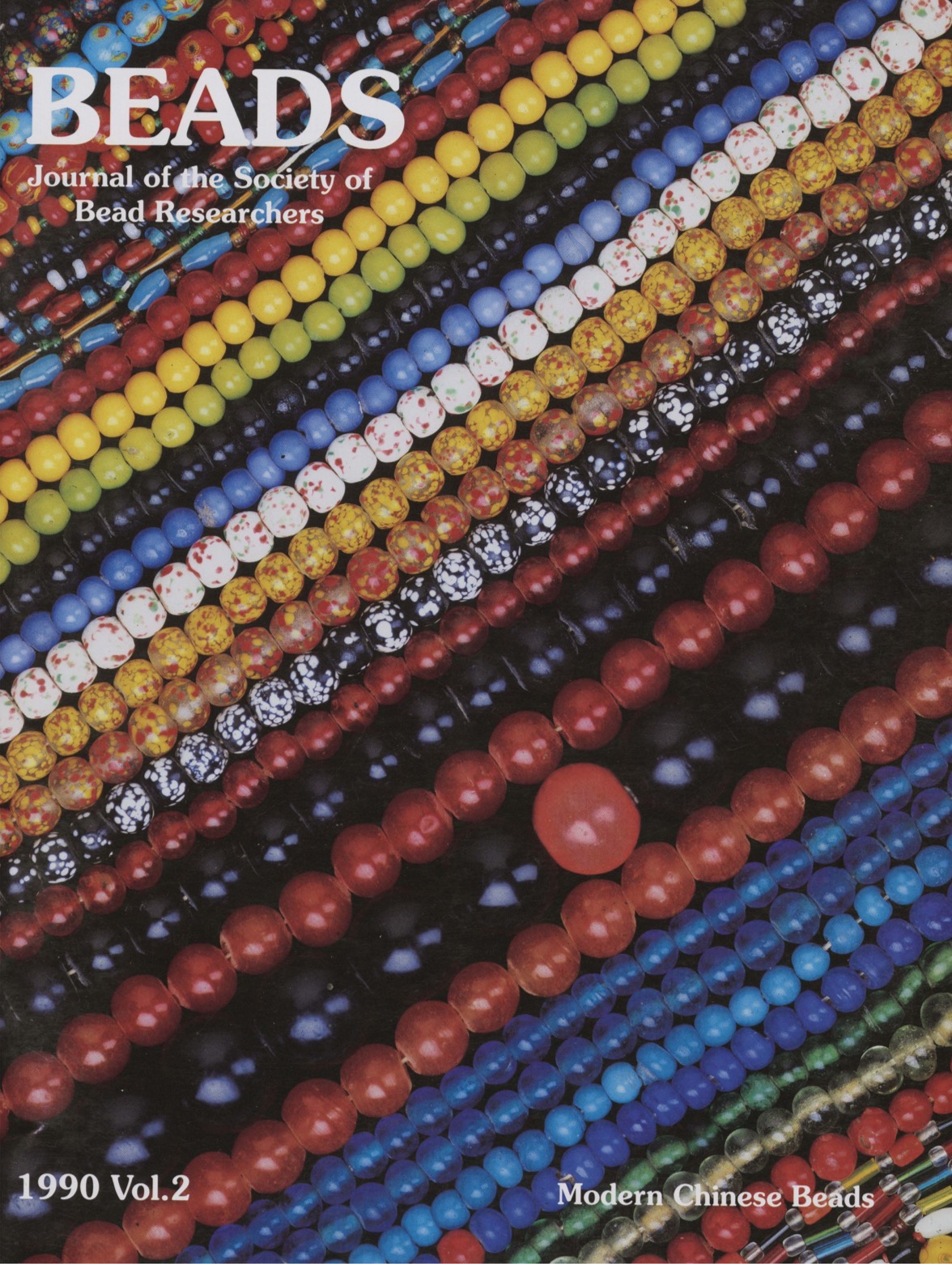
Cover of Volume 2, featuring Modern Chinese Beads

Issue description

Beads is published annually by the Society of Bead Researchers, a non-profit scientific-educational organization which aims to foster serious research on beads and beadwork of all materials and periods, and to expedite the dissemination of the resultant knowledge. Subscription is by membership in the Society. Membership is open to all persons involved in the study of beads, as well as those interested in keeping abreast of current trends in bead research.

Articles

  1. Observations and Problems in Researching the Contemporary Glass-Bead Industry in Northern China

    The status of glass-bead manufacturing in northern China is undergoing rapid change due to the development of the plastic-bead industry. Several manufacturing plants, including the large Beijing Glass Ware Factory, are no longer making beads and several other plants are contemplating changes. The variety of domestic glass beads available for purchase today would indicate a greater number of manufacturing sites than are mentioned in the popular literature.

  2. Beadmaking in Islam: The African Trade and the Rise of Hebron

    This paper complements one which appeared in Volume 1 of this journal, as it also deals with beads in the Islamic world. However, the present work takes a somewhat different approach, being based primarily on historical sources. It also has a different geographical orientation, dealing with commerce between the Islamic world and the northern portion of Africa. Concentrating mostly on the period from the 12th to the 20th century, it documents the rise of a new beadmaking center at Hebron, in the West Bank. The name “Kano beads” has recently been assigned to one class of Hebron beads, and their history is an object lesson in the complexities of the bead trade.

  3. Trade Beads from Hudson's Bay Company Fort Vancouver (1829-1860), Vancouver, Washington

    Archaeological excavations conducted at Hudson’s Bay Company Fort Vancouver recovered 100,000+ trade beads of 152 varieties, including 80 varieties of drawn, 57 varieties of wound, 10 varieties of mold-pressed, and 3 varieties of blown glass beads, as well as one variety each of “Prosser-molded” ceramic and cut-stone beads. An additional 6000+ beads recovered from excavations at the HBC Kanaka village and riverside complex sites may include 39 additional varieties possibly associated with the HBC occupation. The bead assemblage has contributed to the initial definition of a complex temporal and cultural horizon marker dating from 1829 to 1860 for the Pacific Northwest, and provides insights into mid-19th-century Native-American and Euro-American bead preferences. Analysis of the assemblage demonstrates difficulties inherent in the existing archaeological bead classification system, and suggestions for revisions are discussed.

  4. Dominique Bussolin on the Glass-Bead Industry of Murano and Venice (1847)

    One of the earliest detailed descriptions of the Venetian bead industry is contained in an obscure book published in French in 1847 by the Venetian glassmaker Domenico Bussolin. Intended as a “Guide for the Foreigner,” this work contains much useful information concerning bead manufacturing techniques and the socioeconomic aspects of the industry. To make this text generally available, a translation prepared by Karklins and Adams is provided here.

Reviews